
Summary: From pointing-only to integrated sensing and communication, Chipsbank's UWB remote completes a critical technology iteration. Fusing precise pointing control with UWB radar spatial sensing, it lets devices evolve from "understanding commands" to "reading the room" — paving the way for proactive intelligent experiences in the AI era and enabling smarter upgrades across whole-home, smart audio-visual, and commercial meeting scenarios.
As AI large models accelerate adoption, human-machine interaction is shifting from "command-driven" to "experience-driven." As the core interaction entry point for smart large screens, the remote's iteration directly determines the quality of the user's intelligent experience. From traditional button remotes and infrared remotes, to air-mouse control and UWB precision pointing remotes, and now to new interaction forms that integrate spatial sensing, the industry has always pursued more natural, more human-aware, and smarter ways to interact.
Among them, UWB pointing remotes — with centimeter-level positioning, no cursor drift, and low-latency control — have thoroughly solved the pain points of low precision and cumbersome operation that plagued traditional remotes, becoming a mainstream configuration for premium smart hardware. But traditional UWB remotes still have a core shortcoming: they offer pointing interaction only. They can passively receive user commands but cannot sense the state of the living environment. In the AI era, users expect smart experiences in which devices proactively understand and serve people — and a remote without spatial sensing clearly cannot carry that expectation.
To break through industry technical barriers, Chipsbank has achieved a key breakthrough with its self-developed high-precision UWB spatial radar algorithm, taking the lead in deep integration of UWB pointing interaction and UWB radar sensing. Leveraging the native UWB ultra-wideband integrated sensing-and-communication characteristics, paired with proprietary core algorithms and single-chip time-division multiplexing, one UWB chip now carries both precise pointing control and spatial radar sensing — no additional sensors required. We also offer a full, mature turnkey solution covering hardware modules, algorithm firmware, software adaptation, and scenario tuning, truly achieving one chip with dual capabilities and laying an entirely new foundation for spatial intelligent interaction in the AI era.

01Pain Points of Traditional SolutionsInteraction and Sensing Remain Separated
Conventional UWB pointing remotes on the market rely on AoA (Angle of Arrival) plus ToF (Time of Flight) ranging, paired with an IMU inertial measurement unit, to accurately calculate the remote's 3D spatial coordinates and pointing angle — enabling "point-and-control" gesture interaction. Compared with traditional infrared and air-mouse solutions, this represents a qualitative leap in interaction precision and smoothness.
But such solutions still have flaws: functionality is limited to "device control" with no "environmental sensing." A UWB pointing remote delivers an excellent TV interaction experience during control, yet it cannot proactively sense human presence, personnel distance, or motion changes in the room.
To implement intelligent features such as human presence detection, screen-off when the user leaves, children's eye protection, and adaptive scene adjustment, manufacturers must additionally attach mmWave radar, infrared human sensing, or other sensors. This approach not only significantly increases hardware BOM cost but also introduces multi-sensor data analysis and processing challenges, greatly constraining mass-production deployment and experience upgrades.
02A Technology BreakthroughUWB Integrated Sensing & Communication - Dual Functions on One Chip
Chipsbank's newly iterated UWB 2-in-1 fusion solution abandons the outdated "interaction + sensing dual-hardware stacking" model. It deeply taps the core advantages of UWB ultra-wideband technology and, based on nanosecond-level ultra-short pulse signal characteristics, achieves integrated fusion of communication interaction and radar sensing. A single chip time-shares all RF, antenna, and baseband hardware resources — with no new sensors required — running two core functions in parallel and giving devices both the ability to "interact with people" and to "read the space." This is precisely the foundation of human-machine collaborative experience in the AI era.
Precise UWB Pointing Interaction - Continuing the Flagship Control Experience
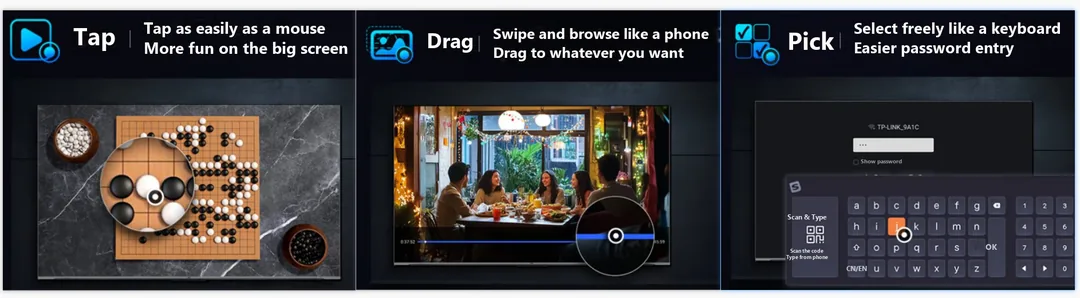
The solution fully retains mature UWB spatial localization and pointing control capabilities. High-precision algorithms resolve the remote's 3D position and pointing angle in real time, continuously outputting a stable, precise absolute cursor position. In daily use, users can easily perform large-screen selection, dragging, circling, and annotation with millisecond-level response — no cursor drift and no operation lag — covering all interaction scenarios from media control and meeting annotation to feature settings.
Native UWB Radar Sensing - Full-Spatial Intelligent Insight
Leveraging real-time monitoring of the UWB Channel Impulse Response (CIR), the system captures subtle changes in spatial signal reflections to accurately identify human micro-motion, breathing, static presence, personnel distance, and movement trajectories. Unlike traditional infrared sensing, which can only detect moving bodies, UWB radar precisely recognizes static humans who are sitting or lying still — thoroughly solving the pain point of smart devices misjudging an empty room and prematurely turning off the screen. It also provides real-time, trustworthy spatial data input for AI large models and intelligent agents, letting AI move from "understanding commands" to "reading the environment."
At the same time, the Chipsbank team employs its self-developed next-generation UWB radar sensing algorithm together with signal isolation and time-division scheduling techniques, optimizing the dual-function signal scheduling mechanism at the chip level — identifying, separating, and coordinately scheduling pointing-interaction and radar-sensing tasks to effectively reduce the mutual interference caused when both signal types operate simultaneously.
Through time-division operation and coordinated processing of pointing control and radar sensing, while ensuring pointing response speed and stability, the system delivers continuous, reliable spatial sensing — enabling one UWB hardware set to serve both precise control and spatial awareness, improving system integration and scenario adaptability.
Based on scenario testing and continuous optimization across complex home and commercial environments, Chipsbank has built a UWB pointing-fusion algorithm and high-precision spatial radar algorithm suite covering pointing localization, spatial sensing, and their coordinated processing. It offers turnkey solutions — from UWB low-level capabilities and algorithm adaptation to application integration — for different product forms and application scenarios, helping customers shorten algorithm development and product tuning cycles and accelerating UWB products from solution validation toward scale deployment.
03Three Core AdvantagesReshaping Industry Mass-Production Standards
Experience Upgrade: From Passive Control to Proactive Intelligence
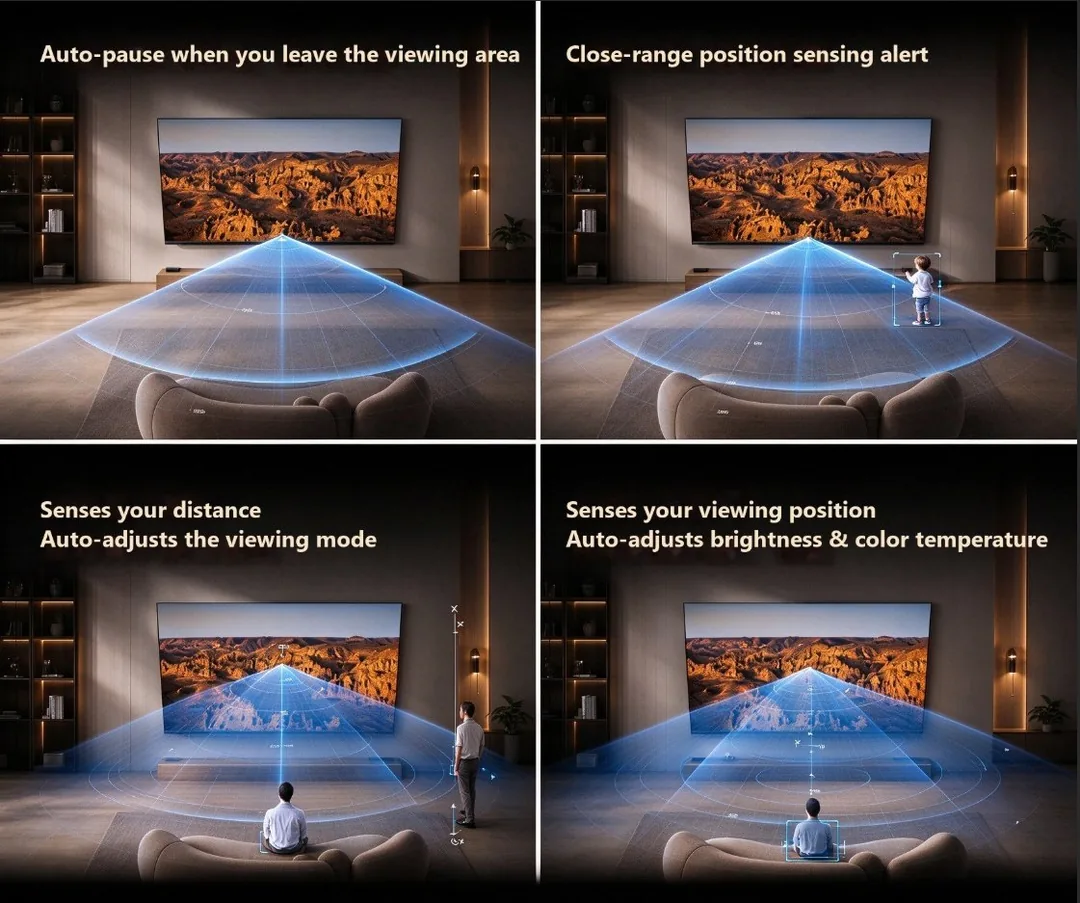
The deep linkage of interaction and sensing frees smart devices entirely from a "passively waiting" state, truly reading user behavior and scenario needs — and gives AI "antennae" to sense the real world. Every time a person approaches and every change in motion becomes real-time input for intelligent decisions. In daily viewing and office scenarios, the system can enable diverse intelligent interactions based on UWB radar sensing data: automatic screen-off standby when people leave the screen and automatic wake when they return; adaptive volume and picture adjustment based on human-device distance; playback continues while the user is seated watching, and the video pauses instantly when the user gets up and leaves — comprehensively elevating an immersive, intelligent AI experience.
Streamlined Hardware: Lower Cost and Consumption, Ready for Mass Production
Compared with traditional dual-module solutions, the 2-in-1 fusion solution eliminates the standalone radar chip, sensing sensors, supporting antennas, and RF circuits — greatly simplifying hardware structure and reusing the same RF, antenna, and baseband hardware resources to effectively reduce BOM cost. At the same time, backed by our mature full-chain turnkey solution, manufacturers directly receive one-stop services covering standardized hardware modules, adapted firmware, proprietary algorithm licensing, whole-machine tuning, and scenario adaptation — significantly shortening product R&D cycles and reducing engineering manpower cost.
Broad Compatibility: Full-Scenario Deployment
This integrated sensing-and-communication solution is highly universal and adaptable — not limited to UWB pointing remotes but applicable to a wide range of smart terminal devices. In the home, it fits smart TVs, smart large screens, and whole-home smart hubs to create a seamless intelligent living experience; commercially, it serves meeting displays and commercial signage with smart power on/off, human-sensing energy saving, and gesture annotation interaction — comprehensively broadening the application boundaries of UWB technology and providing a unified spatial-sensing foundation for all-scenario intelligent upgrades in the AI era.
ConclusionOpening a New Era of Integrated Sensing & Communication Interaction
The evolution of the UWB remote is essentially a revolution in human-machine interaction logic. As AI large models reshape interaction paradigms, sensing capability becomes the prerequisite for devices to "understand people." In the first half of the industry's journey, UWB technology solved the challenge of "precise human-machine interaction," making control more natural and efficient; this pointing + radar 2-in-1 breakthrough opens the second half — letting devices move from "being controlled" to "being aware," evolving from "tools that execute commands" into "partners that understand context."
As the UWB 802.15.4ab standard brings radar sensing into its specification framework, integrated sensing and communication will become the core development trend of UWB technology. Going forward, we will keep deepening UWB core algorithms and hardware optimization — refining solutions with lower power consumption, higher precision, and stronger adaptability — to provide real-time, reliable environmental data input for AI-era intelligent agents and spatial applications, helping smart hardware break free of single-interaction limitations and truly move toward a new AI ecosystem where "devices sense people and scenes adapt to people."