Digital car key
The phone unlocks the car as you approach. UWB distance-binding plus BLE authentication resists relay attacks — no need to take the phone out.

A mobile UWB spatial-sensing solution built on the CBU5000V210 — one phone for digital keys, hands-free transit, smart-home pointing, AR finding and nearby interaction, with Aliro / CCC / FiRa ecosystem support.
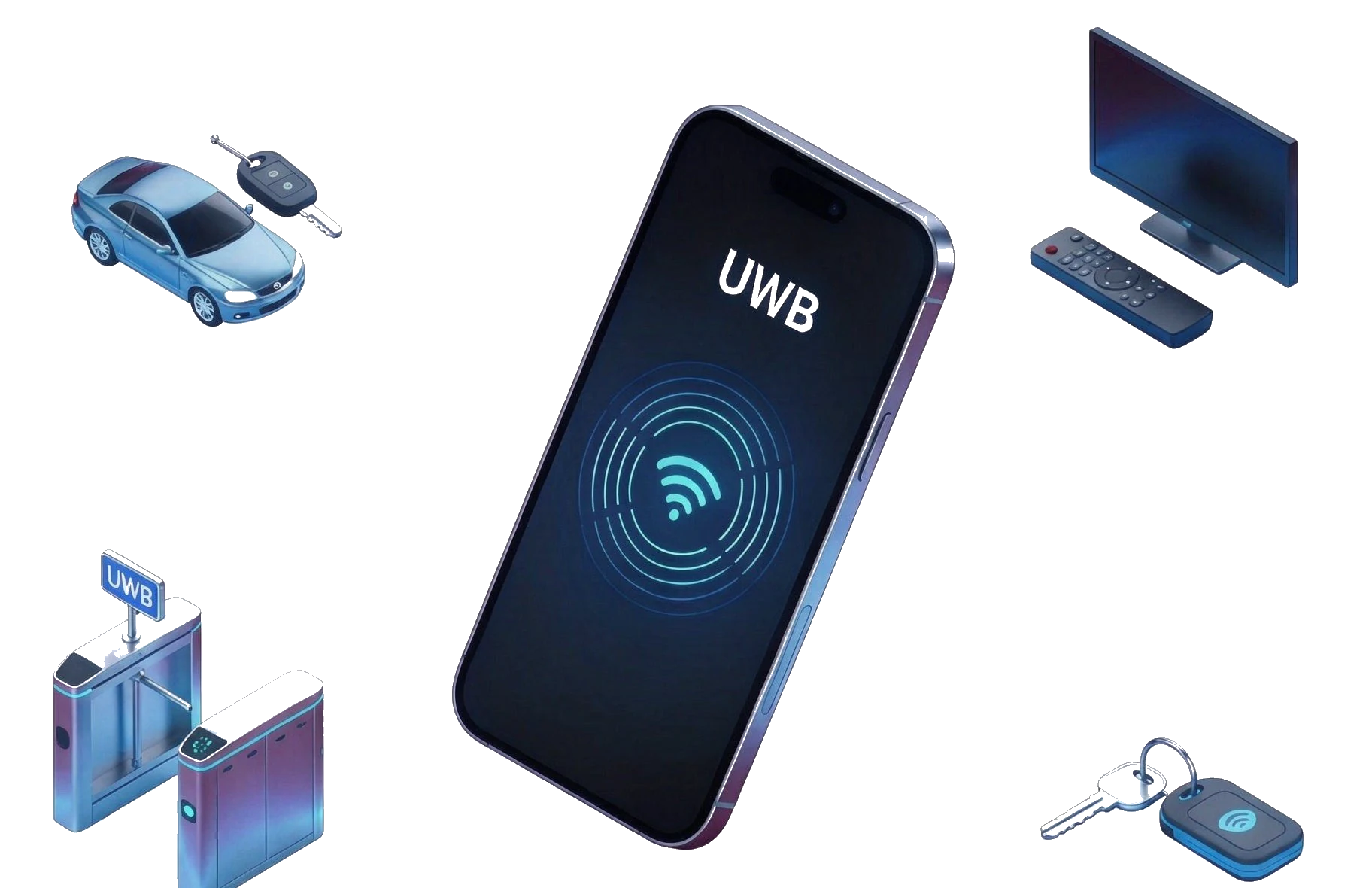
From leaving home to returning, the CBU5000V210 turns the phone into a spatial-interaction hub.
The phone unlocks the car as you approach. UWB distance-binding plus BLE authentication resists relay attacks — no need to take the phone out.
Authenticate through gates or doors while the phone stays in a pocket or bag; AoA determines direction with a 0.5–3 m trigger zone.
Point the phone at a TV, speaker or light to pop up a control card — connect without searching or pairing.
Phone plus UWB tag or anchor delivers centimeter-level direction and distance for finding keys, cars or items.
Two phones near each other can share files, split bills or team up directionally — no QR code or account search.
The same CBU5000V210 extends to low-power radar for gestures, presence and fine motion sensing.
Six dimensions that define the next-generation mobile spatial experience.
ToF two-way ranging at ±3 cm, far beyond RSSI, makes "trigger only when close" possible.
1T3R antenna array supports 3D angle-of-arrival on both azimuth and elevation.
STS scrambling, BLE pairing encryption and optional SE establish an end-to-end trust root.
BLE keeps the connection; UWB wakes on demand. Typical scenarios barely affect phone battery life.
Supports Aliro / CCC / FiRa, ready to connect with mainstream Wallet, automotive and IoT ecosystems.
The same UWB receiver extends to radar for gestures, presence and vital-sign sensing.
The same vision of effortless interaction, but Chipsbank UWB wins on precision, security and experience.
| Item | Chipsbank UWB phone solution | BLE / NFC solution | GPS / Wi-Fi positioning |
|---|---|---|---|
| Positioning accuracy | ±3 cm (ToF) / ±1°–±5° (AoA) | Meter to ten-meter scale, environment-sensitive | Poor indoor accuracy, no direction |
| Anti-relay security | UWB distance-binding + STS, inherently anti-relay | RSSI can be relayed and amplified | No distance sense, cannot prevent relay |
| Interaction | Hands-free / point-to-control / near-to-share | Requires opening app, tapping or swiping | No spatial pointing capability |
| Ecosystem compatibility | Aliro / CCC / FiRa interoperable | Mostly proprietary protocols | Not directly compatible with car keys or payments |
| Power | Wake on demand, millisecond ranging | Needs continuous scanning or NFC coil power | Continuous satellite/scan, high power |
| Extensibility | Same chip extends to UWB Radar | Needs extra sensors for perception | No radar or gesture capability |
From app to UWB air interface: audio and data apps call the middleware over AIDL, the HAL stack manages multi-speaker sessions, SPI drives the CB-series UWB chip, and time-division sessions reach each speaker over the 802.15.4z air interface.
Backed by Aliro / CCC / FiRa standards, Chipsbank provides CBU5000V210 baseband capability, protocol adaptation and engineering delivery.




Ecosystem access, commercial licensing and certification status depend on ecosystem requirements and project verification results.
Antenna, coexistence, power, calibration and certification — Chipsbank covers reference design through mass production.
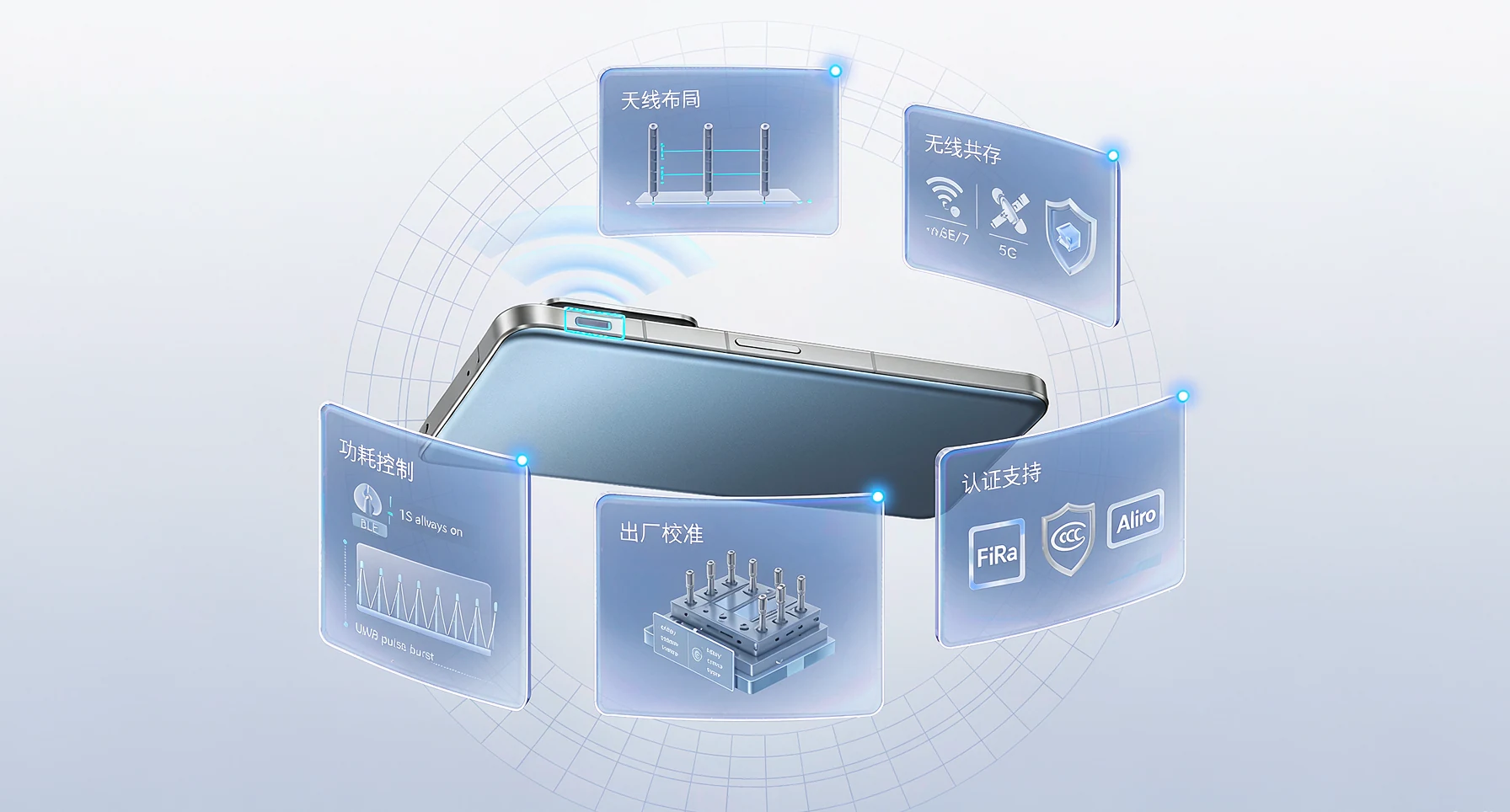
The same CBU5000V210 does more than ranging — it extends to low-power radar for gestures, presence and fine-motion sensing on the phone.
To enable ranging, gestures and presence on a phone traditionally requires multiple sensors and separate algorithms.
Reference design, protocol tuning and certification support — delivered as one package to shorten time to market.