
Chipsbank UWB radar: exploring TV interaction, two-wheeler sentry mode and respiration sensing
Over the past few years, ultra-wideband (UWB) has made its way into phones, cars, door locks, remote controls and smart home products on the strength of centimeter-level ranging, precise pointing and digital keys.
But its value was never limited to how far apart two devices are.
Once a device continuously receives and analyses the reflections around it, UWB can also tell whether anyone is nearby, whether a target is approaching, which zone it is in and whether it is moving — and it can even pick up the subtle changes associated with breathing.
That is the new space UWB radar is opening up.
1. What UWB radar is
A conventional UWB application normally involves two devices exchanging messages: distance comes from time of flight (ToF), and multiple antennas can add direction.
UWB radar works differently:
One device transmits ultra-wideband pulses and simultaneously receives the reflections returned by people, vehicles, furniture and walls. By analysing how those reflections change from frame to frame, it works out what is happening in the space.
Put simply:
- UWB ranging looks at the distance between two devices;
- UWB radar looks at how the space around the device changes.
By processing the returned waveform, a UWB radar can output presence, distance, direction, motion trend, zone status, trajectory and respiration trend, depending on what the product needs.
2. The defining characteristics of UWB radar
1. Non-imaging sensing, better suited to privacy-sensitive spaces
UWB radar does not capture faces, images or audio. It analyses how radio reflections change.
It therefore answers "is anyone there, are they moving, which zone are they in," rather than "who is this person and what do they look like."
That makes it a valuable form of sensing wherever privacy matters: bedrooms, elderly care, hotel rooms, meeting rooms and TV interaction.
2. From "someone is here" to "here is where they are"
A conventional PIR sensor mostly detects obvious heat and motion. UWB radar can layer distance, direction and zone information on top, helping a device build a far more specific picture of the space.
For example:
- whether a person is approaching the device;
- whether they have entered a defined zone;
- whether they are still present in the space;
- whether they are moving closer, moving away or standing still;
- which zone has just changed.
This moves smart devices from a crude "someone triggered me" response toward genuine spatial understanding.
3. Sensitive to very small changes
A person who appears motionless is not actually motionless.
The rise and fall of the chest during respiration, or a slight shift in posture, both leave faint traces in the returned signal. With time-series analysis, filtering and tracking algorithms, UWB radar can attempt to extract trends associated with respiration.
That opens up directions worth exploring: static presence confirmation, sleep observation support, elderly care, infant care and contactless interaction.
4. It combines with ranging, pointing and interaction
What sets UWB apart is that it is not a single-purpose sensing technology.
The same platform can be combined, according to product requirements, to deliver:
- precise ranging;
- pointing detection;
- presence sensing;
- zone detection;
- trajectory tracking;
- micro-motion and respiration trend sensing;
- secure interaction and digital keys.
For TVs, remotes, locks, two-wheelers and smart home products, positioning, pointing and radar sensing can work together rather than in isolation.
3. Where the industry stands: UWB moves from positioning toward sensing and interaction
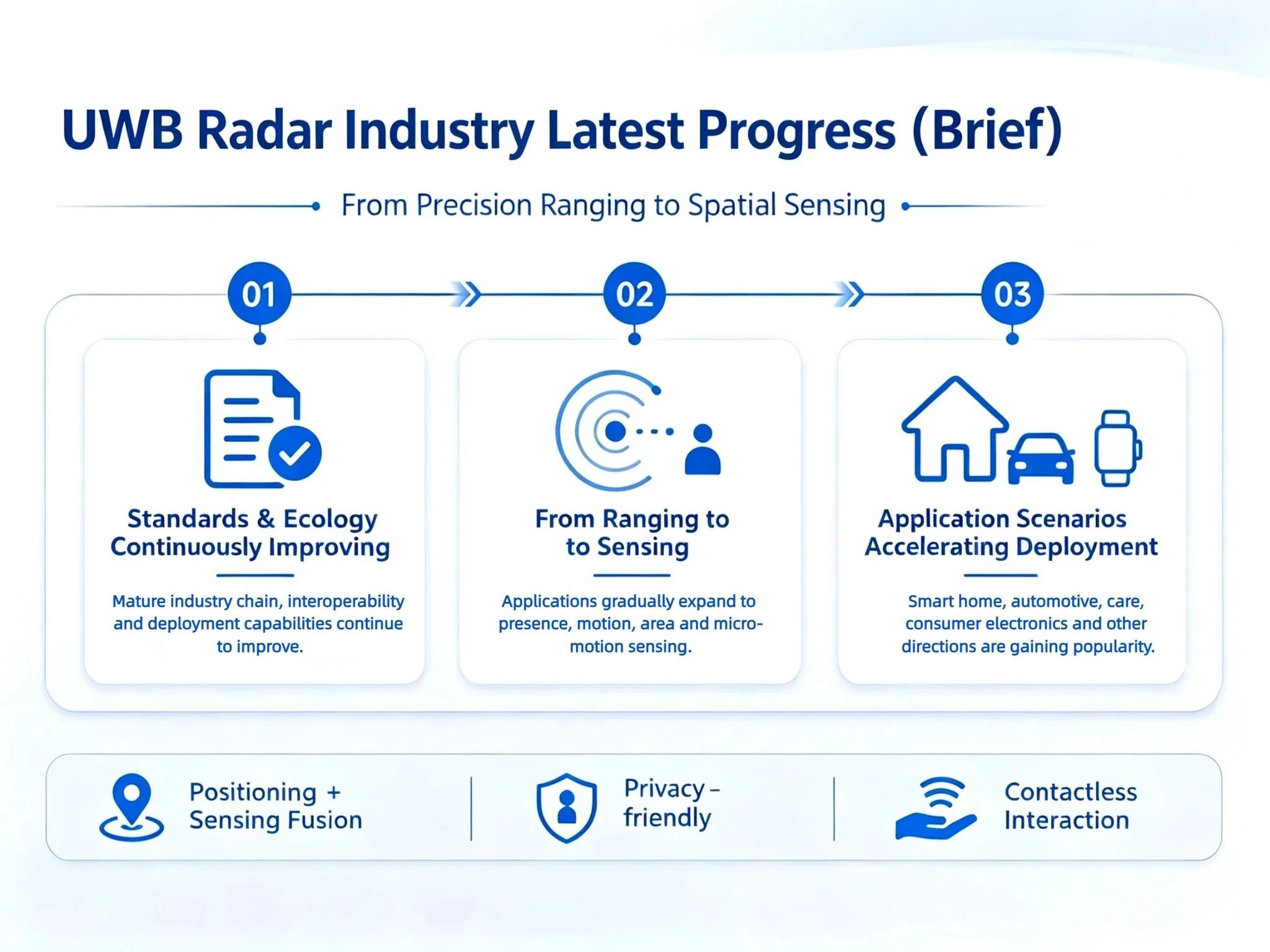
The direction of the UWB industry is becoming clear: pure precision ranging is giving way to a fusion of positioning, connectivity, secure authentication and spatial sensing.
FiRa published its Core 4.0 specification and certification programme in 2025, continuing to drive interoperability and ecosystem adoption among UWB devices. In parallel, the industry is exploring UWB for presence detection, in-car child presence detection, micro-motion sensing such as respiration, and contactless interaction in smart homes and consumer electronics.
UWB will no longer be just the technology that finds devices. It will increasingly be how devices understand where users are, what they are doing and what state a space is in.
4. Chipsbank's progress: three UWB radar solutions completed
To bring UWB radar into consumer electronics and intelligent spaces, Chipsbank has validated a number of solutions and continues to refine the algorithms, antennas, mechanical design and end-product experience.
1. Outdoor two-wheeler sentry radar: giving the vehicle awareness of its surroundings
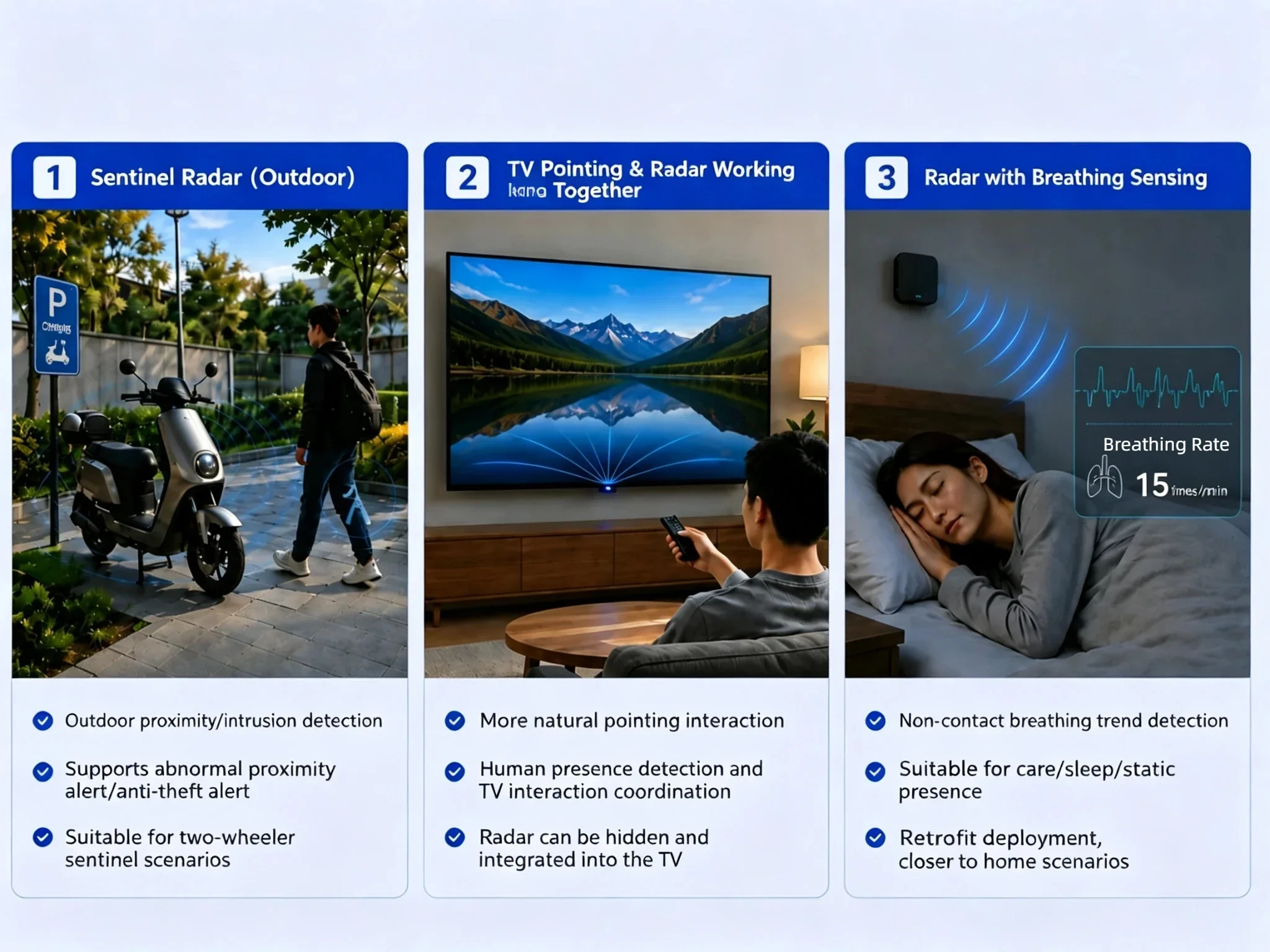
Chipsbank has completed a two-wheeler sentry radar solution for outdoor scenarios.
It detects whether someone is approaching the vehicle, whether a target has entered a configured zone, and how people are moving, providing auxiliary awareness for parking, charging, parked-vehicle watch and anti-theft alerts.
Typical scenarios include:
- approach and intrusion detection in two-wheeler parking areas;
- alerts for people moving around the vehicle;
- detection of unusual approach in charging areas;
- low-power watch once the vehicle is parked;
- integration with alarms, lighting and cameras.
By continuously measuring target distance, entry and exit states and zone changes, UWB radar helps a product recognise abnormal activity around the vehicle and trigger alerts, alarms or device actions as needed.
For sentry-class two-wheeler products, UWB radar delivers spatial awareness without depending on a camera, opening up richer ways to implement parking watch, anti-theft alerts and smart interaction.
2. TV pointing and radar running together: a TV that understands intent
Chipsbank has completed a solution in which precise TV pointing and radar sensing operate at the same time.
In a television, UWB pointing helps the remote deliver more natural directional control, while radar sensing determines whether the user is present, whether they are near the TV, and whether they are inside the effective interaction zone.
The set stops being a passive receiver of key presses. It can further understand:
- whether the user is actually watching;
- whether the current operation is meant for this television;
- whether the user has entered interaction range;
- whether it should wake up, save power or trigger a linked action.
These capabilities extend naturally to directional content selection, multi-user TV interaction, interfaces friendly to children and older users, automatic power saving, and spatial linkage between the TV, speakers, lighting and air conditioning.
3. UWB radar with respiration sensing: exploring contactless micro-motion trends
Chipsbank has completed a UWB radar solution with respiration sensing.
By analysing how the reflected signal evolves over time, the system can present trends related to the breathing rhythm and output respiration rate.
Directions worth exploring include:
- static presence confirmation;
- sleep observation support;
- care for older people and infants;
- state-based smart home automation;
- health-oriented consumer electronics;
- contactless spatial interaction.
The solution gives relevant products continuous, low-intrusion, contactless state sensing, further enriching care and smart interaction experiences.
The value of UWB radar is not that it adds one more sensor. It is that it gives the device spatial awareness.
It helps a device understand whether someone is present, where they are, whether they are approaching, whether they are interacting, and whether there is a change of state worth attention.
Chipsbank continues to develop and optimise solutions for UWB sentry radar, coordinated TV pointing and radar, and respiration sensing.
Partners across consumer electronics — smart homes, TVs and audio-video equipment, two-wheelers, locks, health management and care — are welcome to contact us and explore what UWB can do as it moves from precise connectivity to spatial intelligence.

Advancing the UWB industry together, expanding the intelligent connected future. Whether you are exploring a business partnership, a deployment scenario, or an entirely new application idea, we look forward to talking with you, working together and unlocking more of what UWB can do.
Shenzhen Chipsbank Percomm Technologies Co., Ltd.
Tel: 0755-88835998
E-mail: uwb@chipsbank.com
Address: 7F, Building 12, Phase II, Software Park, Kejizhong 2nd Road, Yuehai Street, Nanshan District, Shenzhen