
As Bluetooth trackers sink into a red ocean of poor accuracy and undifferentiated experiences, the UWB TAG (UWB anti-loss tracker) has become one of the hottest segments in consumer electronics on the strength of centimeter-level positioning, directional guidance and strong interference immunity. After several years of development, UWB TAGs have moved from early experimentation to large-scale deployment, with Apple, Xiaomi, Samsung, Motorola and other leading brands launching flagship products and pushing the technology forward.
As a core domestic supplier of UWB chips and complete solutions, Chipsbank keeps pace with the industry. Having successfully joined the Apple MFi Program and launched its own UWB-SEEK app, the company has comprehensively refined and iterated its UWB TAG solution. The result matches the performance of top-tier international products and breaks through the interconnection barriers of the Apple ecosystem, giving hardware makers a low-cost, fast-to-deploy, fully ecosystem-compatible one-stop service as they move to capture the UWB tracker market opportunity.
1. From niche to mainstream: the UWB technology landscape levels up
Often called simply a tracker, the UWB TAG is used to keep personal belongings, pets and valuable assets from getting lost and to track them in real time. It is one of the first UWB products to reach the consumer market. Back in 2021 Apple launched the first-generation UWB Tag, opening the curtain on UWB's push into consumer products; phone makers have piled in ever since, and the industry now has a mature competitive landscape.
The four mainstream products on the market today — Apple AirTag2, the Xiaomi UWB Tag, the Samsung Galaxy SmartTag2 and the Motorola Moto Tag2 — are closely matched on fundamentals such as ranging stability, battery life and hardware durability, which indirectly confirms that domestic UWB chip technology has caught up with overseas vendors across the board.
Yet the industry's pain points remain glaring
Conventional Bluetooth trackers locate by RSSI signal strength, giving them an accuracy of only 1-5 meters, no sense of direction and vulnerability to 2.4 GHz band interference — good enough for nothing more than "roughly finding things." A UWB TAG, by contrast, relies on time of flight (ToF) ranging to achieve precise 10-30 cm centimeter-level positioning, and pairs it with directional guidance for a large gain in interference immunity. It thoroughly resolves the industry's "you know how far, but not which way" problem, and is the inevitable direction of technological upgrade.
2. The Chipsbank UWB TAG solution: deployed across every scenario, leading on four core strengths
Built on market demand and years of accumulated expertise, the Chipsbank UWB TAG solution covers the core scenarios of personal item tracking and commercial asset tracking, serving both the consumer market and the business market, while differentiating itself across four dimensions: performance, experience, cost and ecosystem.
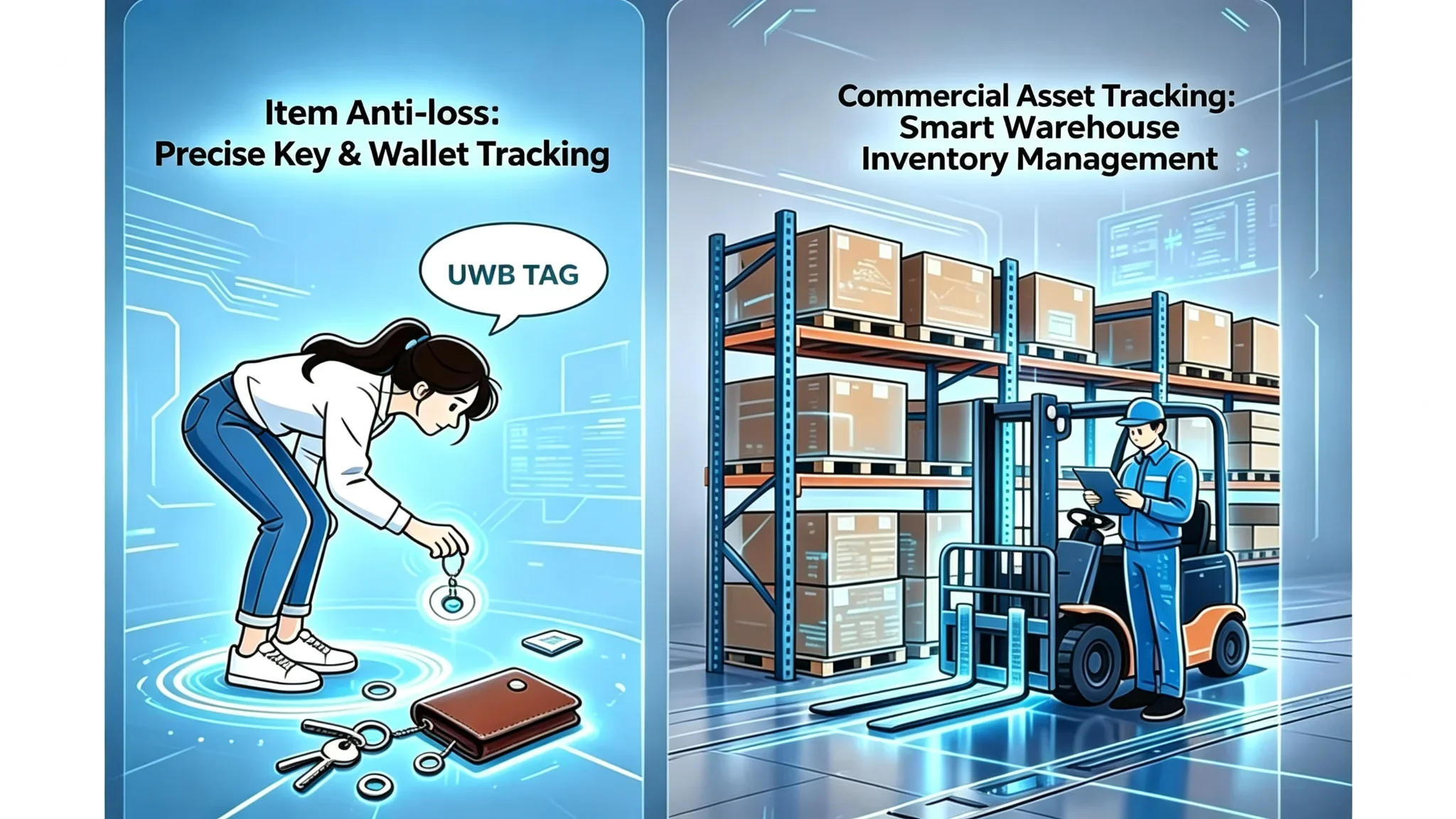
1. Two deployment scenarios that matter
- Tracking personal belongings — for the things that go missing most often: keys, wallets, backpacks, TWS earbuds, suitcases. Centimeter-level positioning plus a real-time directional arrow replaces blind searching with a precise fix, so daily commutes and business trips are far less stressful.
- Commercial asset tracking — for enterprises, warehouses and office buildings, providing real-time location and management of equipment, materials, workwear and other valuable assets, raising asset management efficiency and reducing the risk of loss.
2. Four core product values
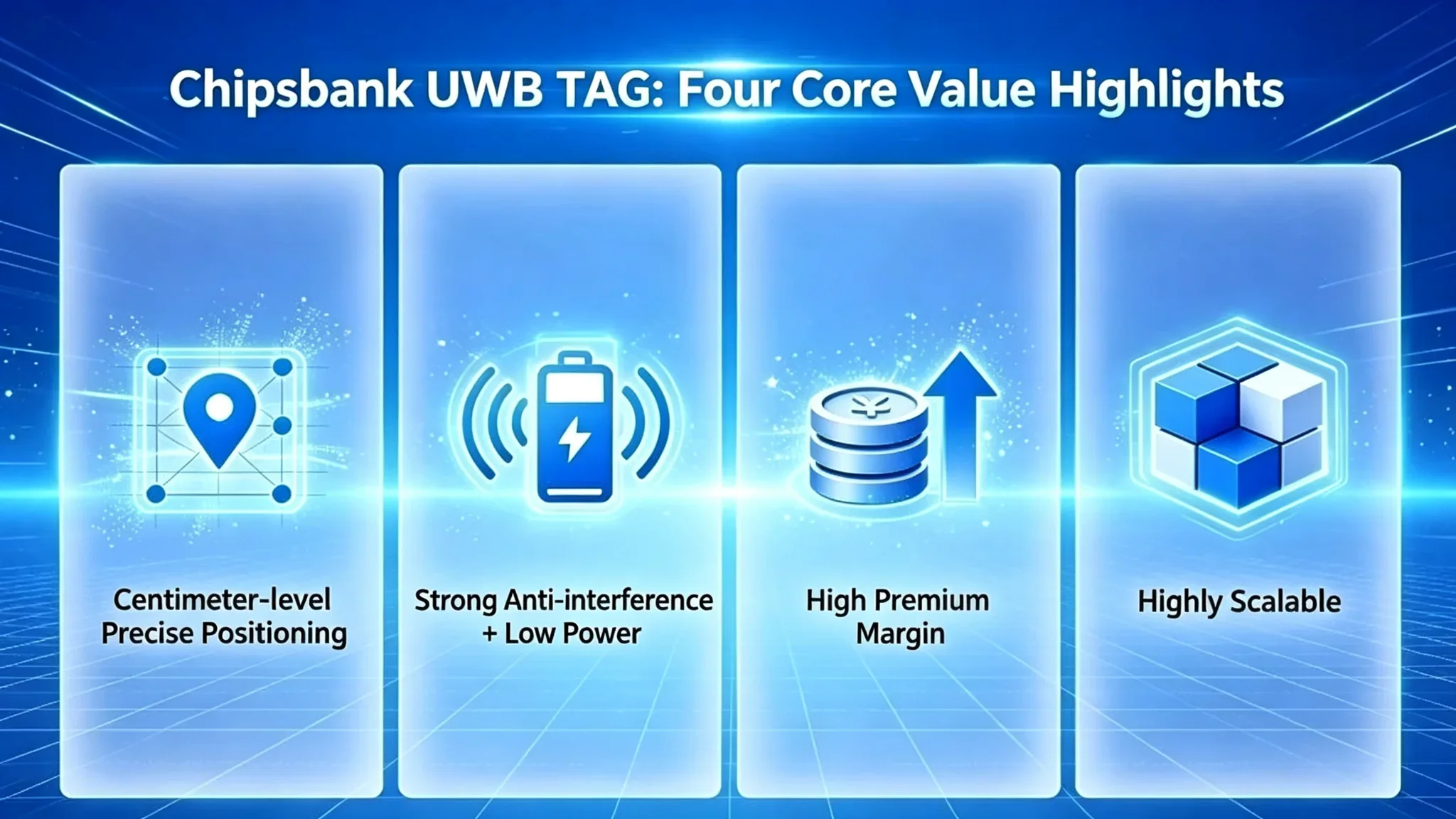
- Centimeter-level accuracy, no more guesswork — positioning accuracy reaches 10-30 cm, and with the dedicated directional arrow the experience moves from the old "it is somewhere around here" to "here is exactly where it is," removing the vagueness that plagues Bluetooth trackers.
- Strong interference immunity plus low power for dependable battery life — it uses the globally available CH9 (8 GHz) band, steering clear of 2.4 GHz Bluetooth and Wi-Fi interference, so signals stay stable even in homes, malls and office buildings crowded with devices. Power consumption is deeply optimised, and a standard button cell delivers long battery life comparable to flagship products.
- Room for premium pricing, an escape from the price war — conventional Bluetooth trackers are stuck in a low-price red ocean, with finished products selling for under 10 yuan. UWB trackers, on the strength of their technology, hold a mainstream price band of 129-249 yuan. A UWB TAG built on the Chipsbank solution commands a clear technology premium and healthy margin, helping vendors step out of the price war.
- Built to extend, ready to link up with the whole home — the UWB TAG is more than anti-loss; it is an entry point into spatial sensing. The solution reserves expansion interfaces that connect seamlessly with smart home control, proximity unlocking and frictionless connectivity, laying the groundwork for whole-home spatial interaction and letting one piece of hardware serve many scenarios.
3. Advantages of the Chipsbank solution
- Highly competitive overall hardware cost, with highly integrated design and an optimised domestic supply chain that brings the BOM down;
- Excellent power management, delivering microamp-level standby and efficient operation in typical scenarios for longer device battery life;
- A turnkey hardware-plus-software package: not just a stable protocol stack and drivers, but a complete reference design that customers can call directly and integrate quickly, sharply reducing R&D investment;
- One-stop service spanning the full flow from design evaluation and prototype validation to mass-production testing, helping customers cross the gap from idea to shipped product fast.
Choosing Chipsbank means choosing a low-risk, high-efficiency path to industrialisation.
3. Industry trends and the road ahead
In 2026 the wireless tracker market keeps growing fast, and UWB — the core direction of the industry's upgrade — is rapidly raising its penetration rate. As UWB chip cost keeps falling and ecosystem standards converge, the UWB TAG will move from a premium flagship accessory into the mass consumer market and become a standard phone companion.
At the same time, plain "find my stuff" functionality no longer satisfies the market. Ecosystem interoperability, multi-scenario linkage and cross-brand connectivity will be the core battleground in the next phase.
Demo video

Advancing the UWB industry together, expanding the intelligent connected future. Whether you are exploring a business partnership, a deployment scenario, or an entirely new application idea, we look forward to talking with you, working together and unlocking more of what UWB can do.
Shenzhen Chipsbank Percomm Technologies Co., Ltd.
Tel: 0755-88835998
E-mail: uwb@chipsbank.com
Address: 7F, Building 12, Phase II, Software Park, Kejizhong 2nd Road, Yuehai Street, Nanshan District, Shenzhen