
After more than a decade of development the smart home industry has matured, and whole-home connectivity has become the mainstream trend. Traditional technologies such as Wi-Fi, Bluetooth and infrared increasingly struggle to meet users' higher-order expectations of a smart experience. As a new-generation ultra-wideband technology, UWB has quickly entered the mainstream on the strength of four core advantages — centimeter-level ranging, high-precision angle measurement, ultra-low latency and strong interference immunity. From the "one-touch connect" phone experience it has spread to air conditioners, TVs, lighting, fans, smart locks and virtually every category of home appliance, becoming the silicon foundation that drives the smart home toward spatial intelligence.
Below, using Chipsbank's UWB chip solutions as reference, we break down the mainstream smart home scenarios, technical strengths and deployment value of UWB chips.

1. Core advantages: why smart homes are adopting UWB chips
Before diving into scenarios, it helps to understand what sets UWB apart from conventional connectivity — the foundation that lets it fit so many appliance categories:
- Exceptional positioning accuracy — centimeter-level ranging and ±1° angle resolution precisely determine device orientation and human position, ending vague, ambiguous control;
- Ultra-low latency — commands stay in sync without stutter, so interaction feels fluid and natural;
- Strong interference immunity — it does not crowd the Wi-Fi or Bluetooth bands, so signals stay stable even in rooms full of appliances, eliminating false triggers and dropouts;
- Easy to deploy — signalling happens locally, so retrofitting needs no extra wiring and works with both new and existing appliances;
- High security — signals are extremely hard to intercept or replay, effectively defeating relay attacks, which suits locks and other privacy-sensitive applications.
Compared with conventional remotes, Bluetooth and smart control hubs, a UWB-based ecosystem leads on directivity, control experience, ease of use and interference immunity — making it one of the best choices for whole-home intelligence at scale.

2. Mainstream scenarios: UWB chips reach every appliance in the home
Drawing on industry benchmark cases, Chipsbank's ecosystem solutions and our own chip deployment experience, we group UWB smart home scenarios into smart air conditioning, entertainment, the ecosystem remote, frictionless access, smart lighting, and safety and care — explained below with illustrations.
Smart air conditioning — human-aware airflow control (the hottest appliance category)
Thanks to precise human ranging and micro-motion sensing, UWB chips are being designed into air conditioners by multiple appliance brands, with a sensing range of up to 8 meters for full-scenario intelligent airflow. It is currently one of the most widely deployed UWB use cases in home appliances.
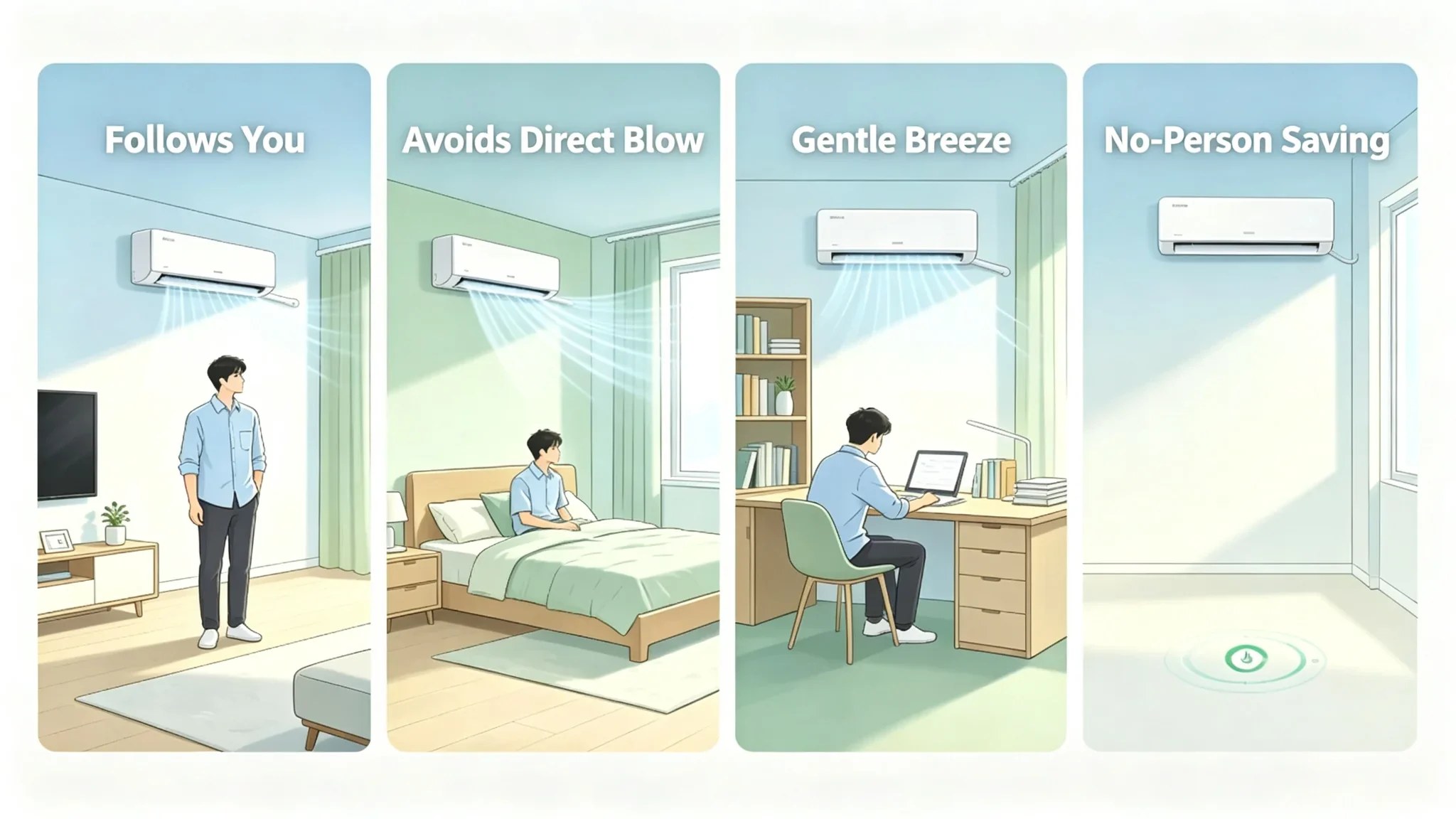
Four core intelligent modes:
- Airflow follows you — the unit tracks body movement in real time, so the airflow follows family members as they move instead of sweeping on a fixed pattern;
- Airflow avoids you — once the body position is identified, the vents steer away from it, preventing cold air from blowing directly onto neck, shoulders or head, and solving the "too cold with it on, too hot with it off" dilemma;
- Soft airflow up close — fan speed is adjusted in steps according to distance, with a soft-air mode engaged within 6 meters for an even feel near and far;
- Energy saving when nobody is home — when the room is empty the unit switches to low-power operation, holding a baseline temperature while cutting consumption.
Some air conditioners on the market use millimeter-wave or NearLink for similar functions, but UWB holds the advantage on positioning accuracy, interference immunity and multi-person detection stability, delivering a better overall experience.
Entertainment devices — immersive TV and audio interaction
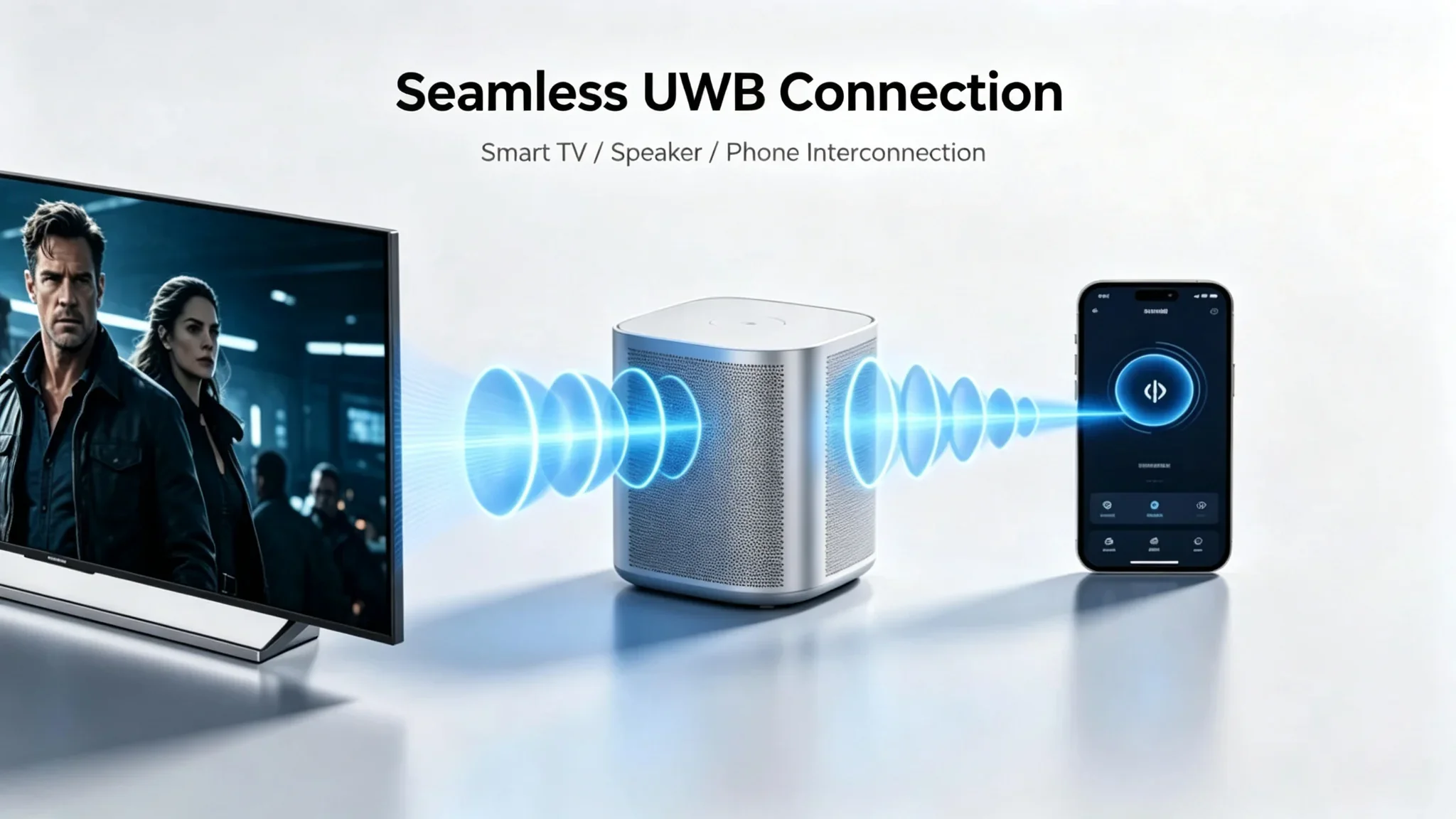
With UWB spatial awareness, TVs and smart speakers break free from the traditional remote and deliver an immersive entertainment experience:
- Music handoff — multiple speakers around the home are linked, so the music follows you, moving to whichever speaker you are nearest for a continuous whole-home soundstage;
- Point and control — point at a speaker to change volume or skip tracks, point at the TV to switch channels or adjust brightness, all in one fluid gesture;
- Multi-device coordination — TV, speakers and lighting work together, so one tap starts cinema mode while the UWB chip triggers commands across every device at once.
UWB ecosystem remote — the whole home at your fingertips
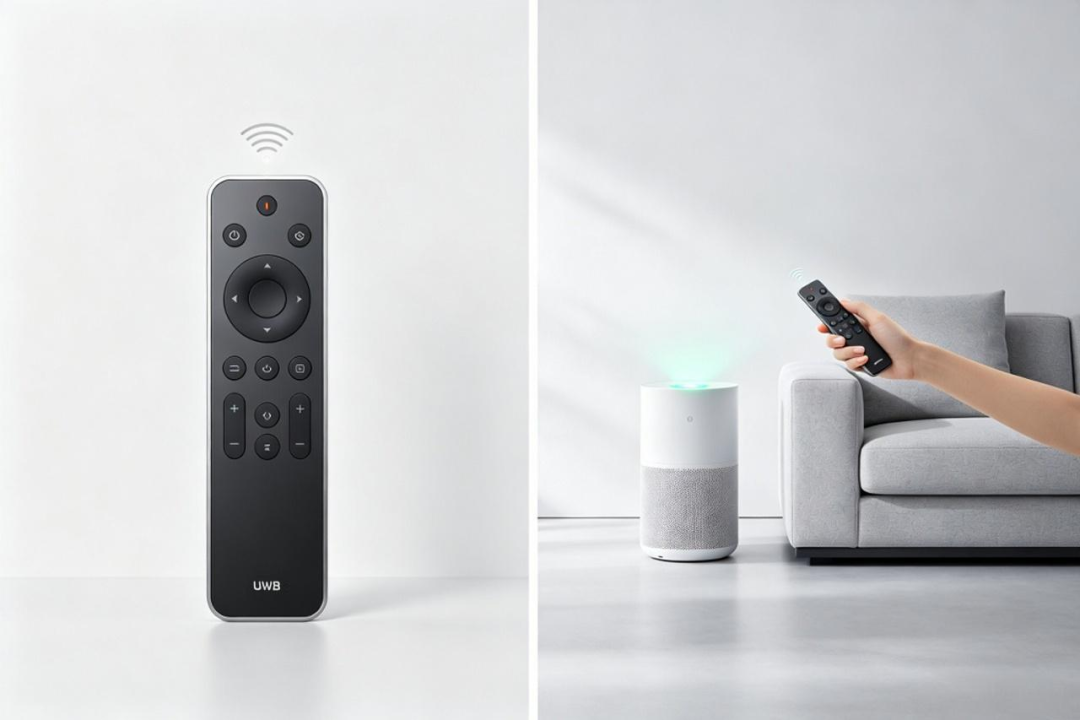
Conventional remotes are fragmented, tedious to pair and prone to misfires. The ecosystem remote built on a UWB chip was created to solve exactly that: one remote for every appliance in the home.
Key advantages:
- Point to control, no pairing — aim at the target appliance and operate it; easy enough for children and older users;
- Strong directivity — unique bearing detection eliminates the misdirected and misjudged commands of infrared and Bluetooth remotes;
- Works offline — no router dependency, so it keeps working during power or network outages;
- Simple to deploy — no wiring, and both new and existing appliances can be retrofitted quickly at low cost.
Solution comparison:
| Solution | Directivity | Interference immunity | Ease of use | Network dependency |
|---|---|---|---|---|
| UWB ecosystem remote | ✅ Precise pointing | Strong, immune to Wi-Fi / co-channel interference | Zero learning curve | Works offline |
| Smart control hub | ❌ No directivity | Susceptible to Wi-Fi interference | Requires learning the app | Network dependent |
| Bluetooth remote | ❌ No directivity | Susceptible to co-channel interference | Requires pairing | Works offline |
| Infrared remote | ❌ No directivity | Susceptible to obstruction | Simple to operate | Works offline |
Frictionless smart locks — the secure, convenient first line of defence
High-precision positioning plus encrypted transmission make UWB a natural fit for the security plus frictionless demands of smart locks, and a core component of premium models.
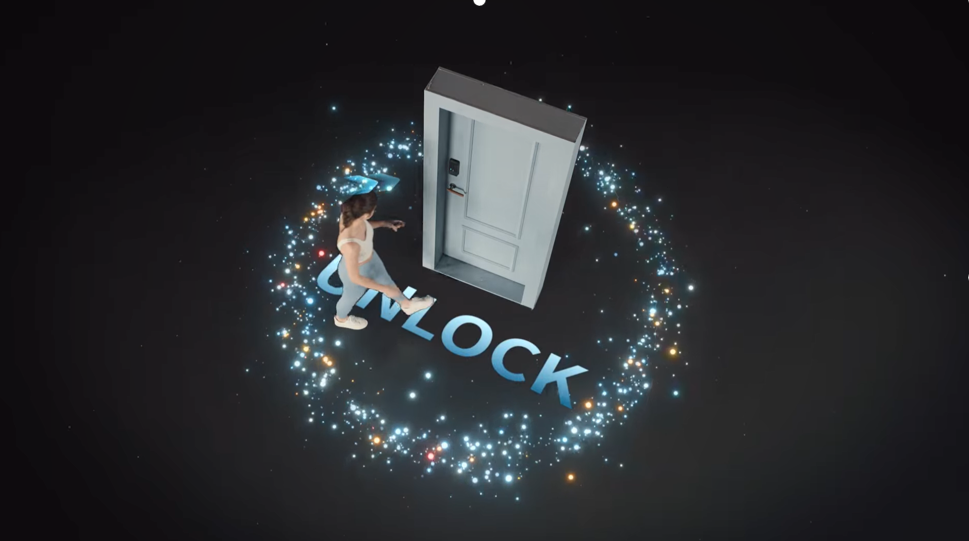
- The door opens as you approach — with a phone or UWB key on you, the chip measures distance and verifies identity in real time and unlocks automatically: no phone out, no fingerprint, no code;
- Multiple layers of security — the encrypted signal resists cracking and relay attacks, reliably distinguishing authorized users from strangers to prevent tailgating and forced entry;
- Automatic relocking — once you leave, the lock engages itself, removing the worry of a door left open;
- Ecosystem compatibility — it connects to phone digital key ecosystems, so one phone key covers your home, your community and your garage.
Smart lighting — light that follows you and adapts itself
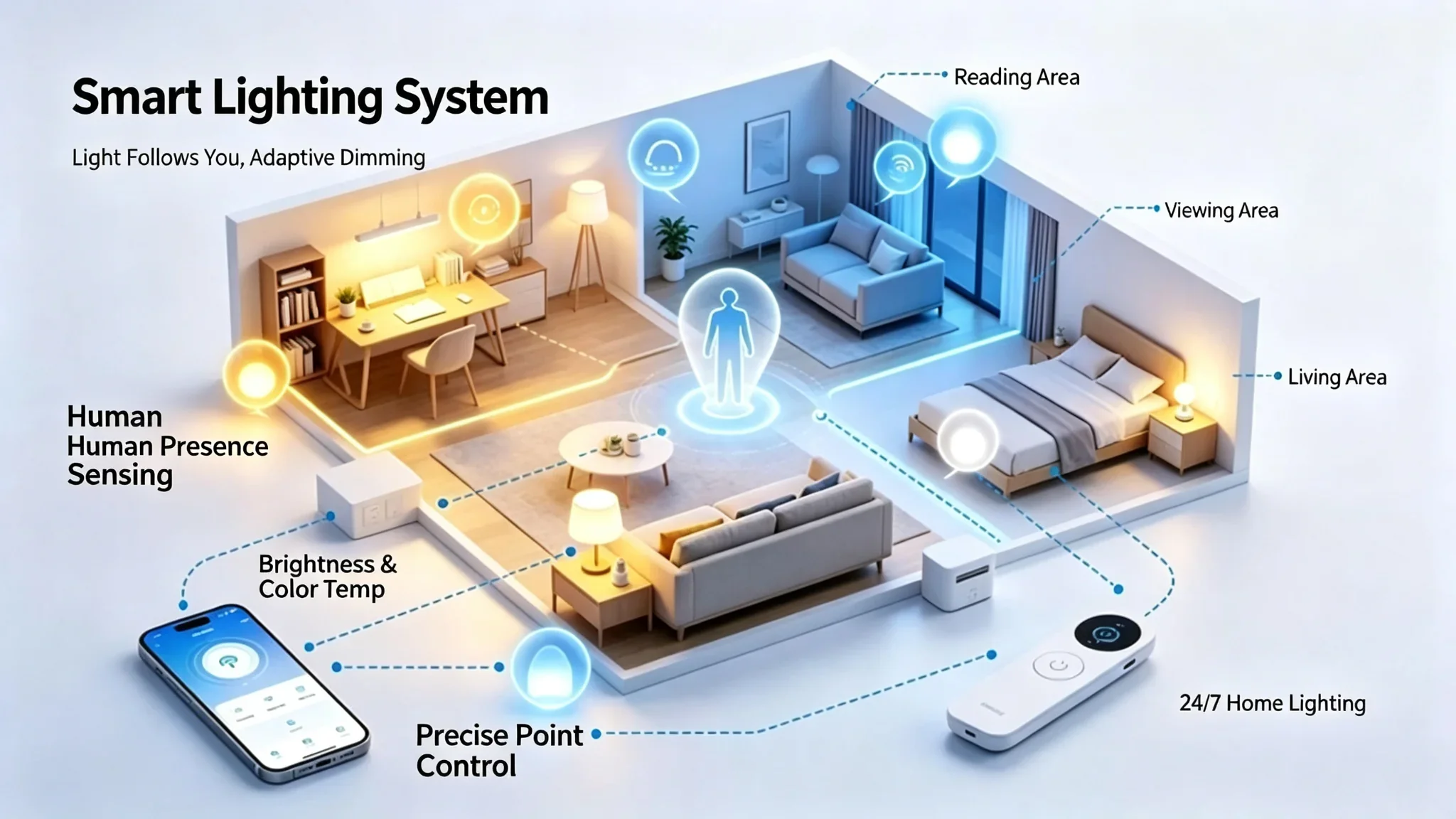
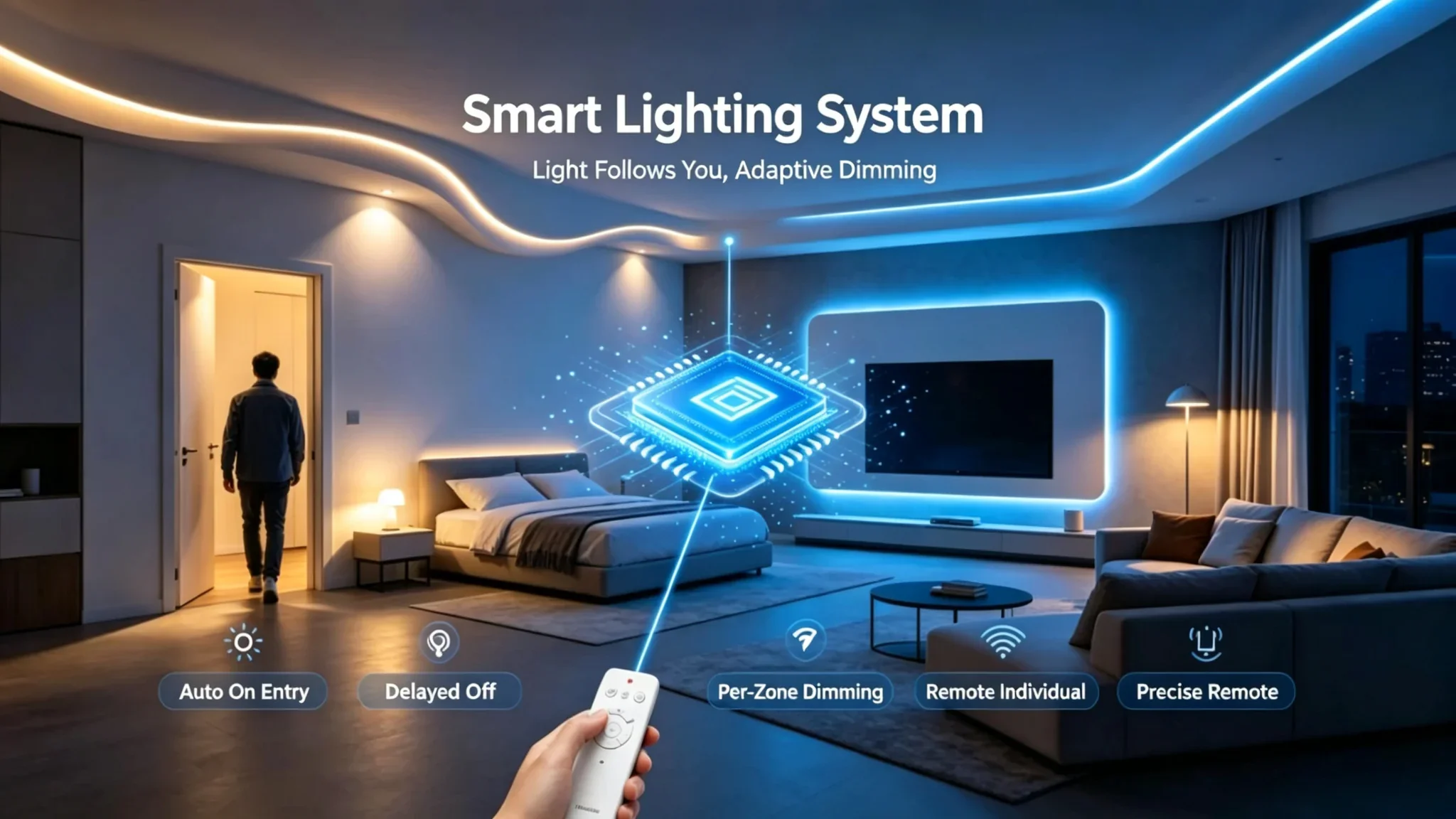
Embedding UWB chips into ceiling lights, spotlights, bedside lamps and ambient lighting creates dynamic lighting across the whole home:
- Lights on when you arrive, off when you leave — body position is sensed in real time: the room lights up as you enter and switches off after a delay once you leave, no manual switching;
- Zoned dimming — brightness and colour temperature are adjusted per zone, warm light for reading and cool light for watching a film;
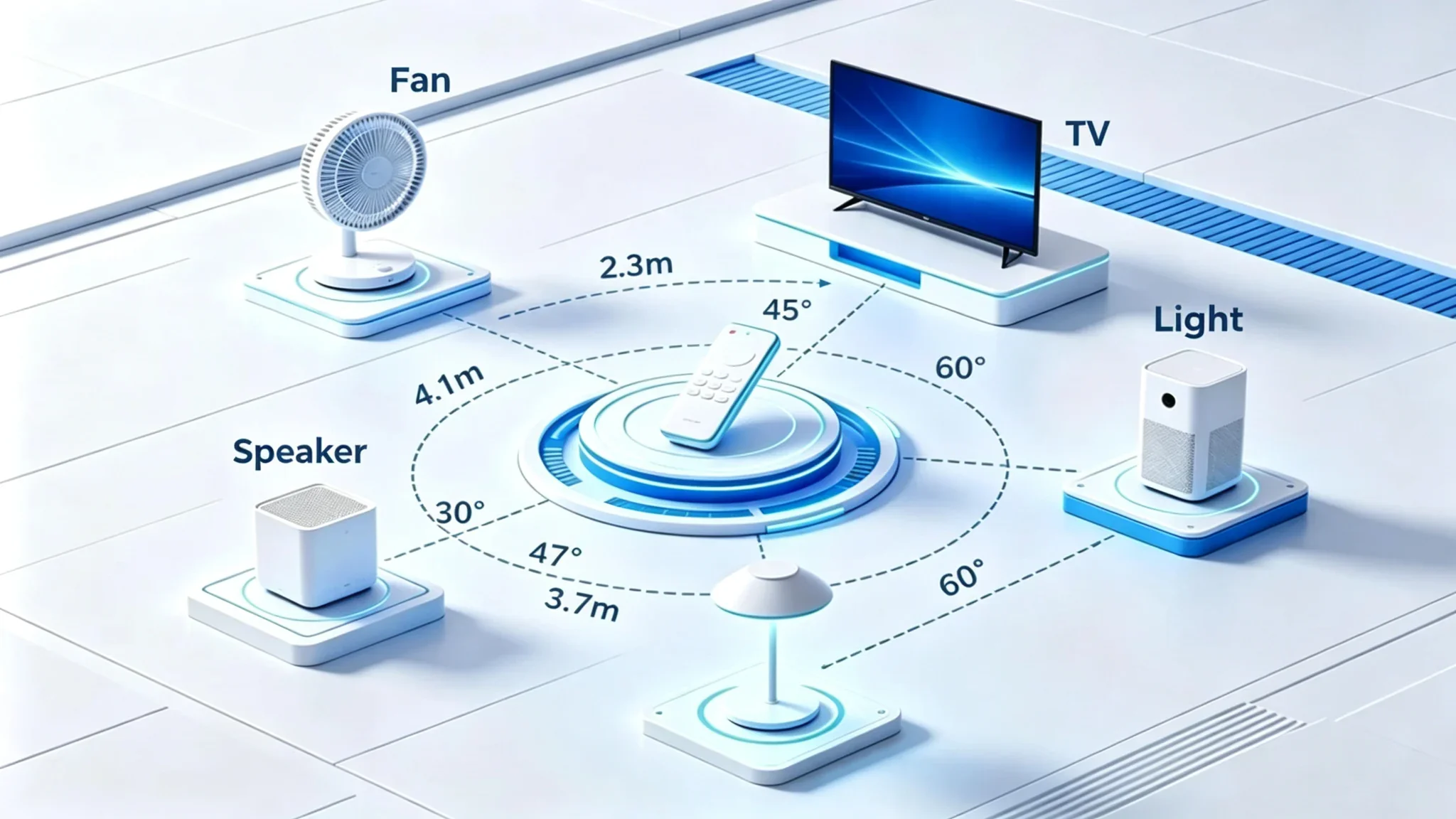
- Point-to-control lighting — aim a phone or ecosystem remote at a fixture to switch it or dim it, and single out one lamp even when several sit in a row;
- Scene linkage — arriving home triggers the entryway light, getting up at night triggers the bedside night light, covering every lighting need through the day.
Home safety & elderly care — an invisible guardian
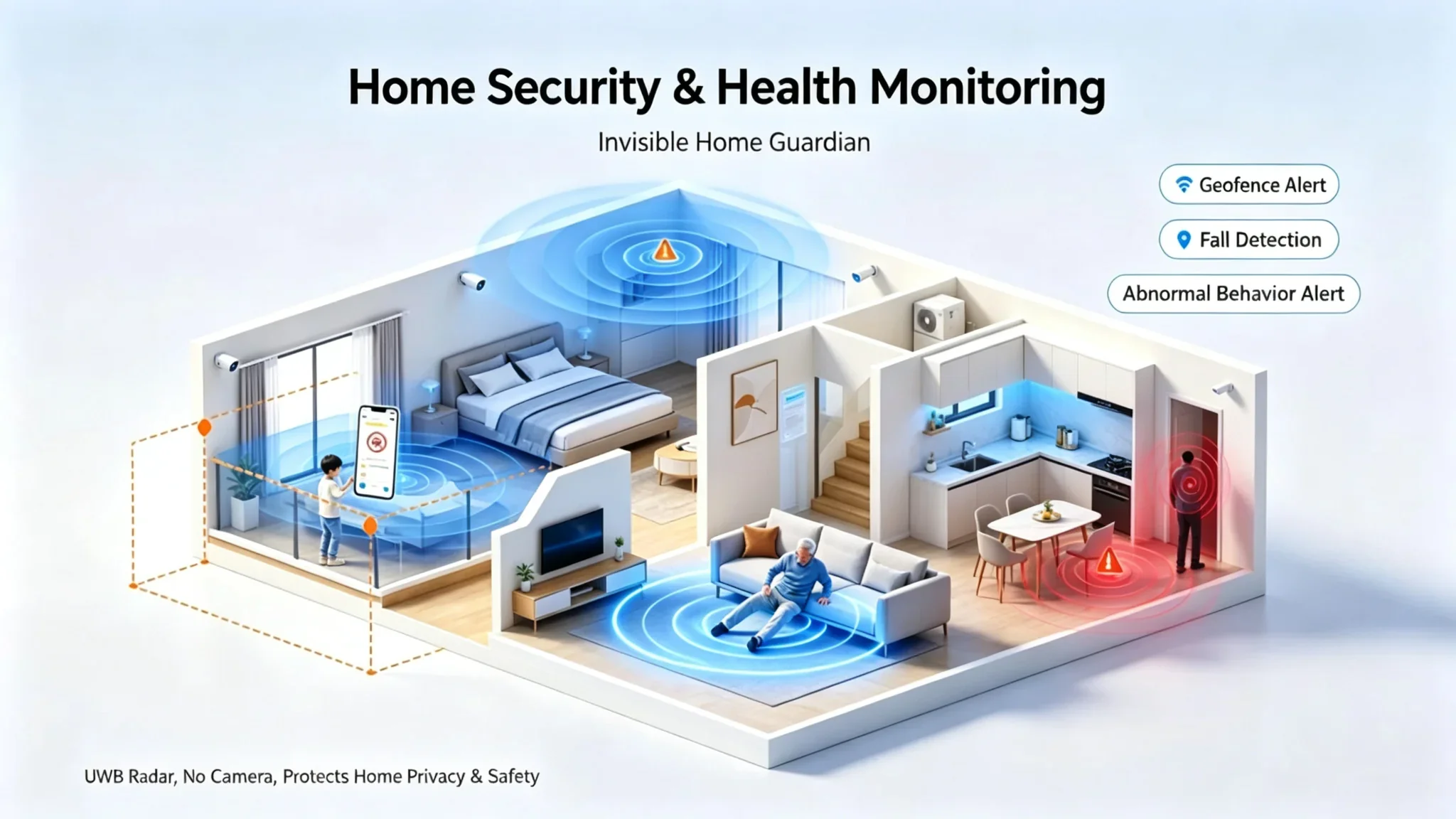
Using UWB radar sensing, which detects micro-motion and even breathing, the home gains private security and care for children and older residents without a single camera:
- Geo-fence alerts — virtual fences around risky spots such as balconies, bay windows and kitchens push an alert to your phone the moment a child comes close;
- Fall detection for older residents — posture and micro-motion analysis identifies an accidental fall and notifies family members immediately, supporting safer ageing at home;
- Abnormal behaviour alerts — long periods with no activity or an unfamiliar presence trigger an automatic alarm, balancing security and privacy while avoiding the leak risks of cameras.

3. Industry today and where it goes next: UWB is about to become standard
Appliances with UWB inside are still in the early adoption phase, concentrated in premium phones, flagship TVs, smart air conditioners and high-end locks, with overall market penetration still low. But after years of iteration the application logic and deployment playbook are fully mature, and leading appliance makers have all completed their technical roadmaps.
Future trends:
- Cost falls, adoption spreads — as domestic UWB chip vendors reach volume production, chip cost keeps dropping, and within five years UWB will move from flagships down to refrigerators, washing machines and small appliances across the board;
- Ecosystem convergence — brand barriers come down and cross-brand UWB devices interoperate, finally delivering a true "whole-home UWB ecosystem";
- Capability upgrades — point control and human sensing are joined by AR interaction, whole-home positioning and health monitoring;
- Becoming standard — just as Wi-Fi is today, UWB will become a baseline technology in mid- to high-end smart appliances.

4. The value of Chipsbank UWB chips: enabling every scenario
As a dedicated UWB chip vendor, we invest deeply in ultra-wideband R&D and volume production, and offer highly integrated, low-power, highly adaptable UWB chip solutions for smart home use:
- Fits every scenario — compatible with phones, air conditioners, TVs, luminaires, remotes, smart locks and every other appliance category, with standardized chips plus reference designs;
- Full performance — stable centimeter-level positioning, ±1° angle measurement and low latency, with reliable signalling in complex home environments;
- Easy to integrate and retrofit — a compact chip that fits both new and existing appliance hardware, lowering production and R&D cost;
- Complete solution — matching algorithms, antenna designs and debugging tools, a one-stop service that gets customers to product faster;
- Low-power design — suited to battery-powered remotes, locks and portable devices, extending product battery life.

Advancing the UWB industry together, expanding the intelligent connected future. Whether you are exploring a business partnership, a deployment scenario, or an entirely new application idea, we look forward to talking with you, working together and unlocking more of what UWB can do.
Shenzhen Chipsbank Percomm Technologies Co., Ltd.
Tel: 0755-88835998
E-mail: uwb@chipsbank.com
Address: 7F, Building 12, Phase II, Software Park, Kejizhong 2nd Road, Yuehai Street, Nanshan District, Shenzhen