
UWB has been steadily gaining momentum over the past few years.
From spatial awareness in smartphones to automotive digital keys; from indoor positioning to point-and-control interaction in the smart home; from asset tracking to radar sensing scenarios such as human presence detection and respiration detection — UWB is turning from a relatively niche wireless technology into an essential foundation for short-range spatial interaction.
But it is no longer enough to think of UWB simply as a high-precision positioning technology.
With IEEE 802.15.4ab moving forward, the boundaries of what UWB can do are expanding once again. The focus is shifting away from "how accurate is the measurement" and toward a systematic set of capabilities: stronger links, lower power, lower latency, richer sensing, and ranging plus communication in more demanding scenarios.
This article starts with the evolution of UWB technology, outlines the main changes IEEE 802.15.4ab brings over IEEE 802.15.4z, and then walks through the key HRP-UWB device capabilities defined in 802.15.4ab: EMDEV, SDEV, ARDEV and LLDDEV.
1. Why UWB Still Needs to Keep Evolving
UWB stands for ultra-wideband (UWB).
Unlike conventional narrowband wireless communication, UWB transmits information using extremely short pulses spread across a very wide spectrum. Its core advantage is that large bandwidth, which provides the foundation for high-precision ranging, sensing and data transfer.
The UWB technology family keeps evolving on top of the IEEE 802.15.4 standard.
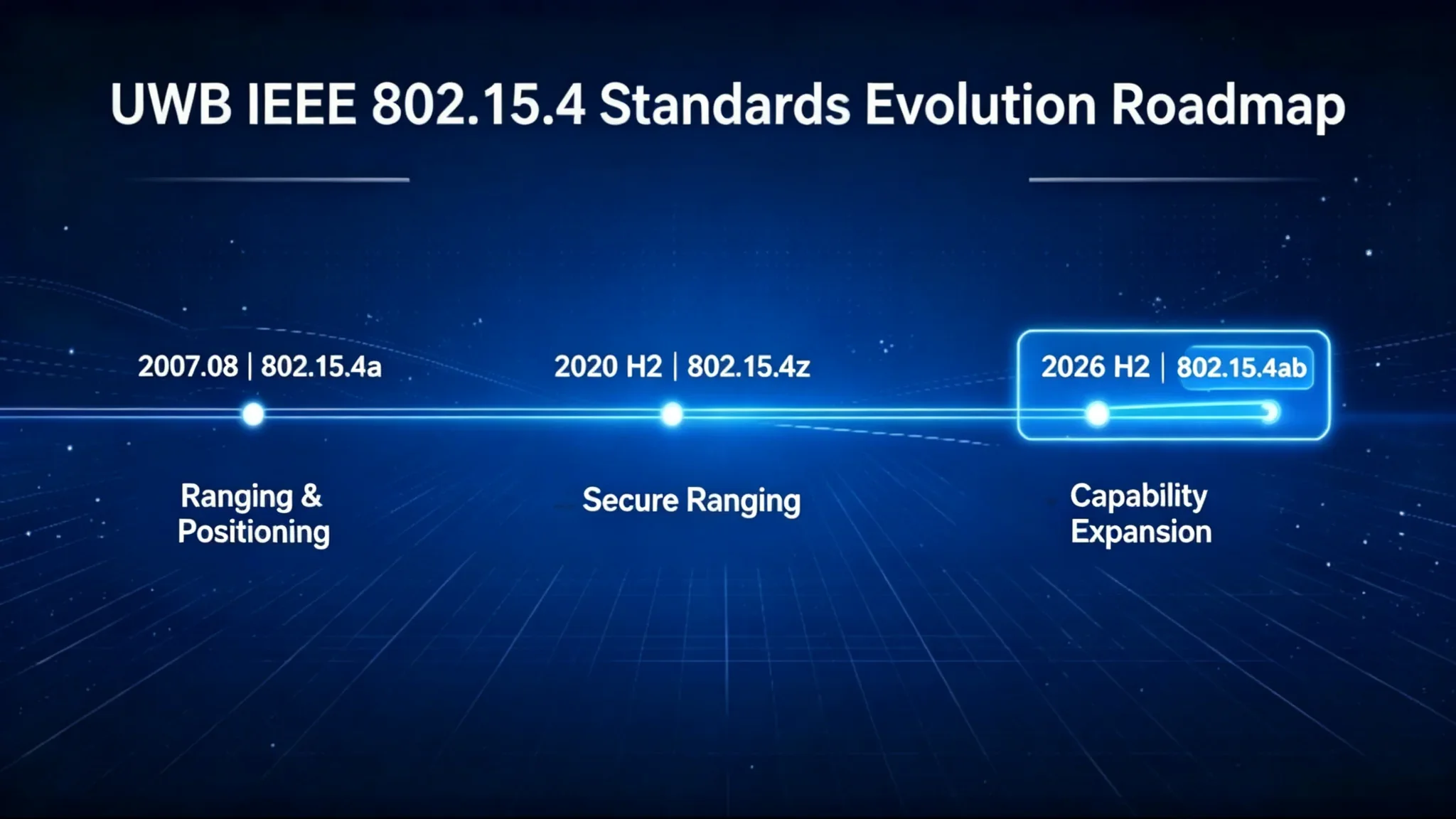
IEEE 802.15.4a introduced the HRP-UWB PHY for ranging and positioning; IEEE 802.15.4z then enhanced HRP-UWB on that basis, with a particular focus on secure ranging. IEEE's own description of 802.15.4z notes that the amendment strengthens the UWB PHY with additional coding options, improves ranging integrity and accuracy, and extends the MAC to control the time of flight (ToF) ranging procedure and to exchange ranging information.
If the keyword for 802.15.4z was "secure ranging", the keyword for 802.15.4ab is closer to "capability expansion".

2. From 802.15.4z to 802.15.4ab: UWB Moves from Ranging to a Multi-Capability Platform
IEEE 802.15.4ab is the next-generation evolution of the UWB standard. IEEE describes it as an enhancement of the UWB PHY, the MAC and the associated ranging techniques, while remaining backward compatible with ERDEV, that is, Enhanced Ranging Capable Devices.
The scope of the 802.15.4ab enhancement is very broad: coding, preamble and modulation schemes, but also new operating frequencies, interference mitigation, high-integrity ranging, low-power mechanisms, narrowband assistance, UWB sensing, as well as low-power low-latency streaming and high data-rate streaming.
IEEE 802.15.4ab is trying to answer a bigger question:
Now that UWB is already inside phones, cars, IoT devices, smart homes and industrial deployments, what other capabilities does it need in order to support the next generation of short-range wireless applications?
The HRP-UWB extensions in 802.15.4ab are best understood as four classes of device capability:
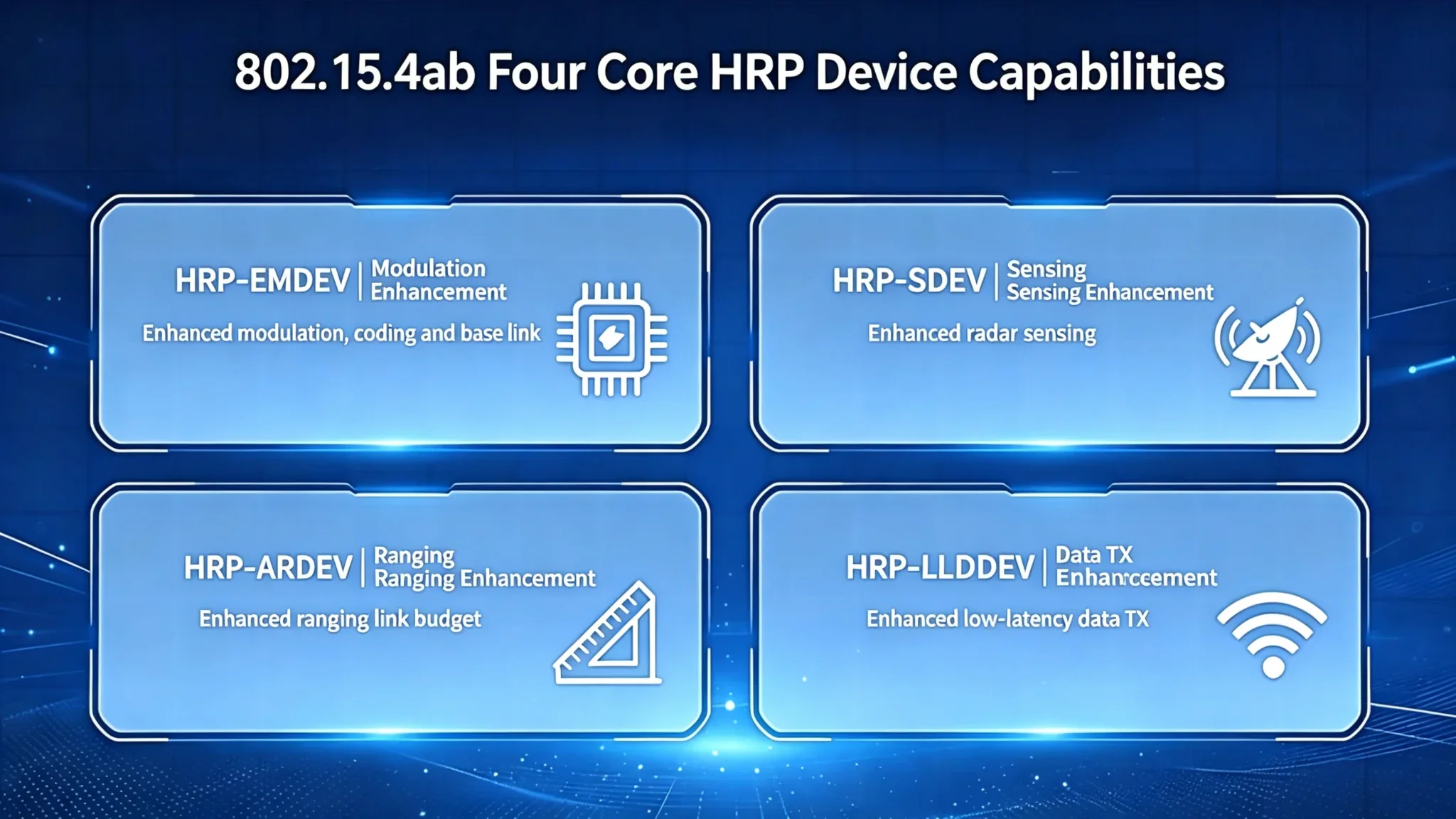
In practice, 15.4z already introduced HRP-ERDEV. On top of that, 15.4ab further defines and strengthens HRP-EMDEV, and adds capability directions such as HRP-SDEV, ARDEV and LLDDEV.
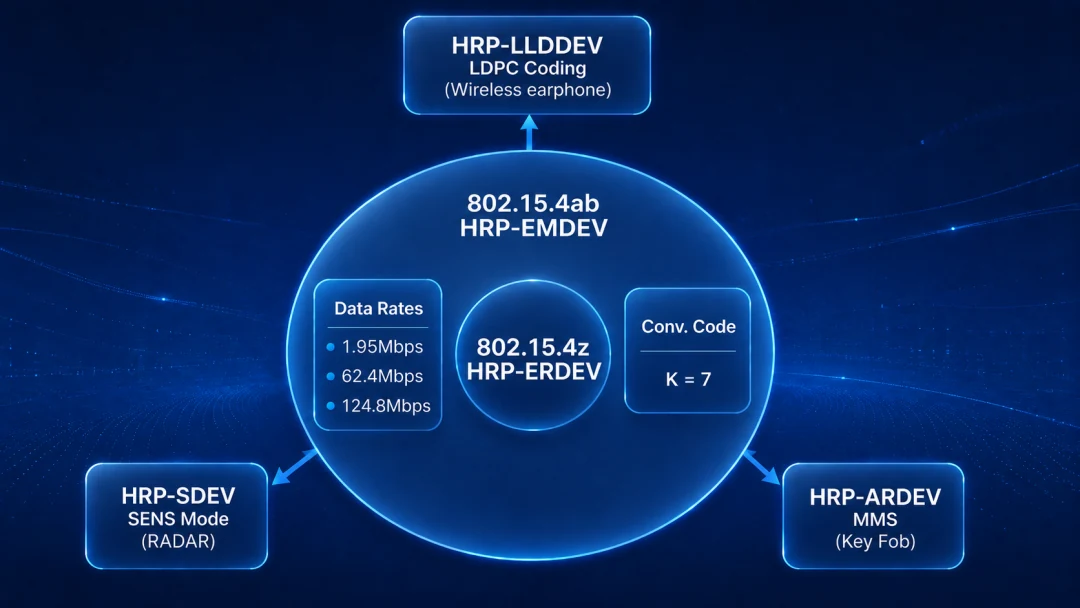

3. HRP-EMDEV: The Foundation Enhancement Layer of 802.15.4ab
HRP-EMDEV is best understood as the baseline enhanced mode for HRP-UWB in 802.15.4ab.
Its purpose is to give UWB a stronger physical layer: more powerful coding, a richer set of modulation modes, more flexible data rates, and the groundwork that later supports low-latency data, enhanced ranging and sensing.
On the coding side, HRP-EMDEV makes K=7 convolutional coding mandatory for the PHR and the payload, and requires support for both lower and higher rates: 1.95 Mbps, 62.4 Mbps and 124.8 Mbps.
This means 802.15.4ab offers far more room to trade off link reliability, interference immunity and transfer efficiency. Different applications care about different things: a digital key cares about security and stability; low-latency interaction cares about delay and throughput; sensing cares about waveform shape and bandwidth.
HRP-EMDEV is therefore not an isolated feature. It is the foundation on which the other advanced capabilities of 802.15.4ab are built.

4. HRP-SDEV: UWB Sensing Starts to Be Standardized
If EMDEV is the foundation enhancement, then SDEV is one of the most notable directions in 802.15.4ab.
The core of SDEV is this: it takes UWB beyond ranging and positioning and further into radar sensing.
UWB sensing has already been explored widely across the industry, for example human presence detection, respiration detection, gesture recognition, range profile analysis and space occupancy detection. But at the standard level, if sensing waveforms, data formats and reporting methods differ too much between vendors, a genuinely interoperable ecosystem is hard to build.
HRP-SDEV in 802.15.4ab takes a more systematic approach to standardizing UWB sensing, and begins to specify exactly what a UWB packet used for sensing should look like.
In this mode, SENS configuration 0 is mandatory while configurations 1 and 2 are optional, and SENS uses the same preamble code as SYNC and SFD.
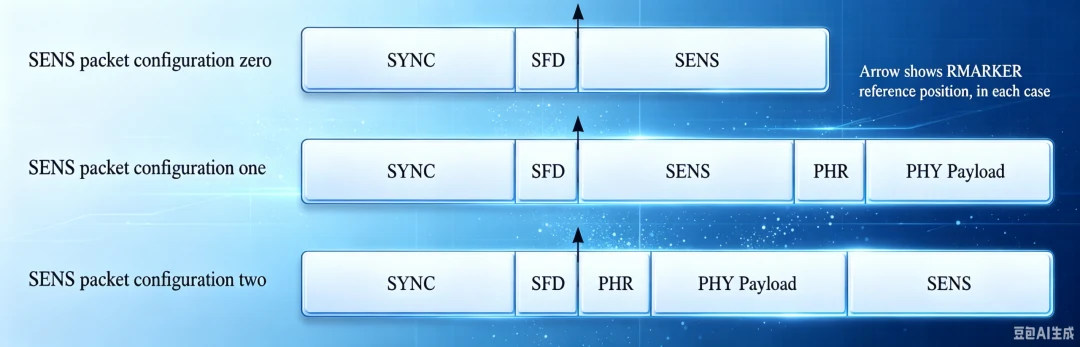
SDEV also involves several other key features.
- Sensing pulse shape
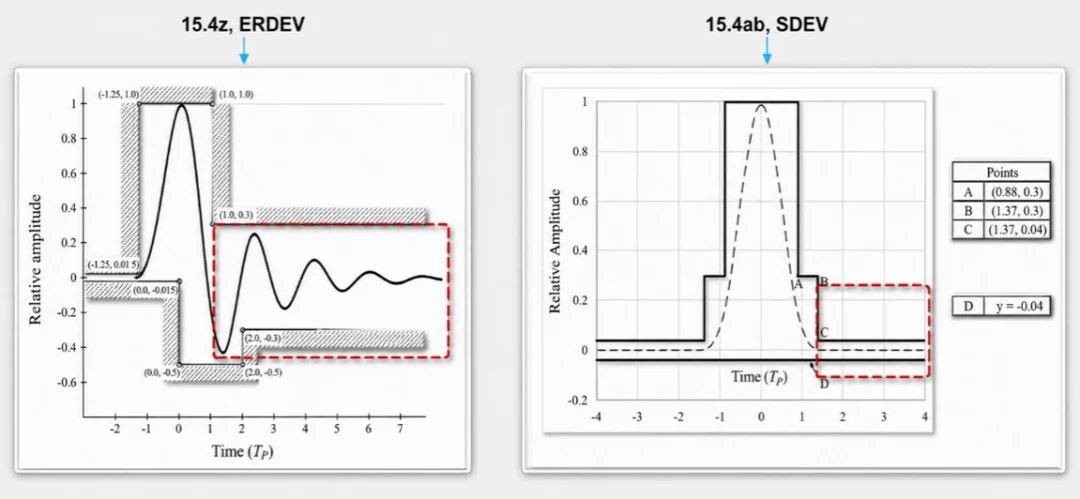
15.4ab SDEV imposes stricter requirements on the baseband pulse shape than 15.4z ERDEV does.
In sensing scenarios the time-domain shape of the transmitted pulse matters a great deal. Radar sensing relies on the echo, so if the transmitted waveform itself has a long tail, or its leading and trailing energy is not clean enough, interpreting that echo becomes harder. SDEV therefore tightens the pulse shape requirement: leading and trailing energy must stay below 4%, whereas ERDEV only constrains the leading energy of the pulse.
By constraining the sensing pulse shape more explicitly and more strictly, SDEV helps different devices behave more consistently in sensing scenarios.
- Frequency stitching
Frequency stitching is an optional HRP-SDEV feature that can operate within a packet, across packets, or in a hybrid manner. It requires coherent accumulation and twice the aggregate sampling rate. In other words, it combines several frequency bands or frequency resources into a larger aggregate bandwidth, improving sensing or ranging performance.
For UWB radar, wider bandwidth generally means better time-domain (range) resolution, so frequency stitching opens up room for finer-grained spatial sensing.
- CIR reporting
SDEV also defines a CIR reporting mechanism that supports different bitmap lengths. All reported CIR measurements use the first-path detection point as the reference, with I/Q at 16 bit by default and 10 bit, 12 bit or 14 bit as options.
CIR, or Channel Impulse Response, is extremely important information in a UWB system. The phase and delay information it carries is the basis for the higher-layer information required by ranging, angle of arrival (AoA) measurement and sensing.
Standardizing CIR reporting therefore makes it much easier for UWB sensing applications to converge on a common data interface.
Seen from this angle, HRP-SDEV will be the key step with which 802.15.4ab brings UWB into the era of integrated sensing and communication.

5. HRP-ARDEV: A Link Budget Boost for Ranging
ARDEV is best understood as the device capability aimed at advanced ranging, and one of its most important elements is MMS.
MMS stands for Multi-Millisecond Ranging Sequence.
Conventional UWB ranging typically relies on short packet exchanges, whereas MMS accumulates signal energy over a much longer ranging sequence, which creates an opportunity to improve ranging performance at low signal-to-noise ratio or in complex environments. The principle is that MMS takes care of ranging enhancement only, while data communication tasks such as control and result reporting are handed over to other mechanisms. The standard defines two paths in detail:
- UWB-Driven MMS, which uses the HRP-UWB PHY for communication;
- NBA-MMS, which uses the O-QPSK PHY for communication.
- UWB-Driven MMS: better suited to improving ranging stability in boundary conditions
UWB-Driven MMS is the approach explicitly defined in 15.4ab. Its core limitation is that UWB still carries the data communication, so the ceiling on link capability remains bounded by UWB data sensitivity. UWB-Driven MMS mainly raises the signal-to-noise ratio through accumulation, which improves ranging accuracy near the sensitivity limit, but it does not truly improve ranging sensitivity. A more accurate statement is therefore:
The main value of UWB-Driven MMS is that near the sensitivity boundary, accumulating over a multi-millisecond sequence improves the signal-to-noise ratio, which in turn improves ranging stability and accuracy.
- NBA-MMS: a larger link budget, but higher system complexity
Unlike UWB-Driven MMS, NBA-MMS introduces a narrowband assistance mechanism. It covers 5725–5850 MHz and 5925–6425 MHz with a total of 250 narrowband channels, and uses channel hopping or frequency diversity to provide more robust access and to mitigate the effect of multipath fading.
In NBA-MMS the narrowband part handles communication, control and reporting, so the link budget is no longer bounded by UWB data sensitivity and can be improved more effectively. The resulting link budget improvement is shown below.
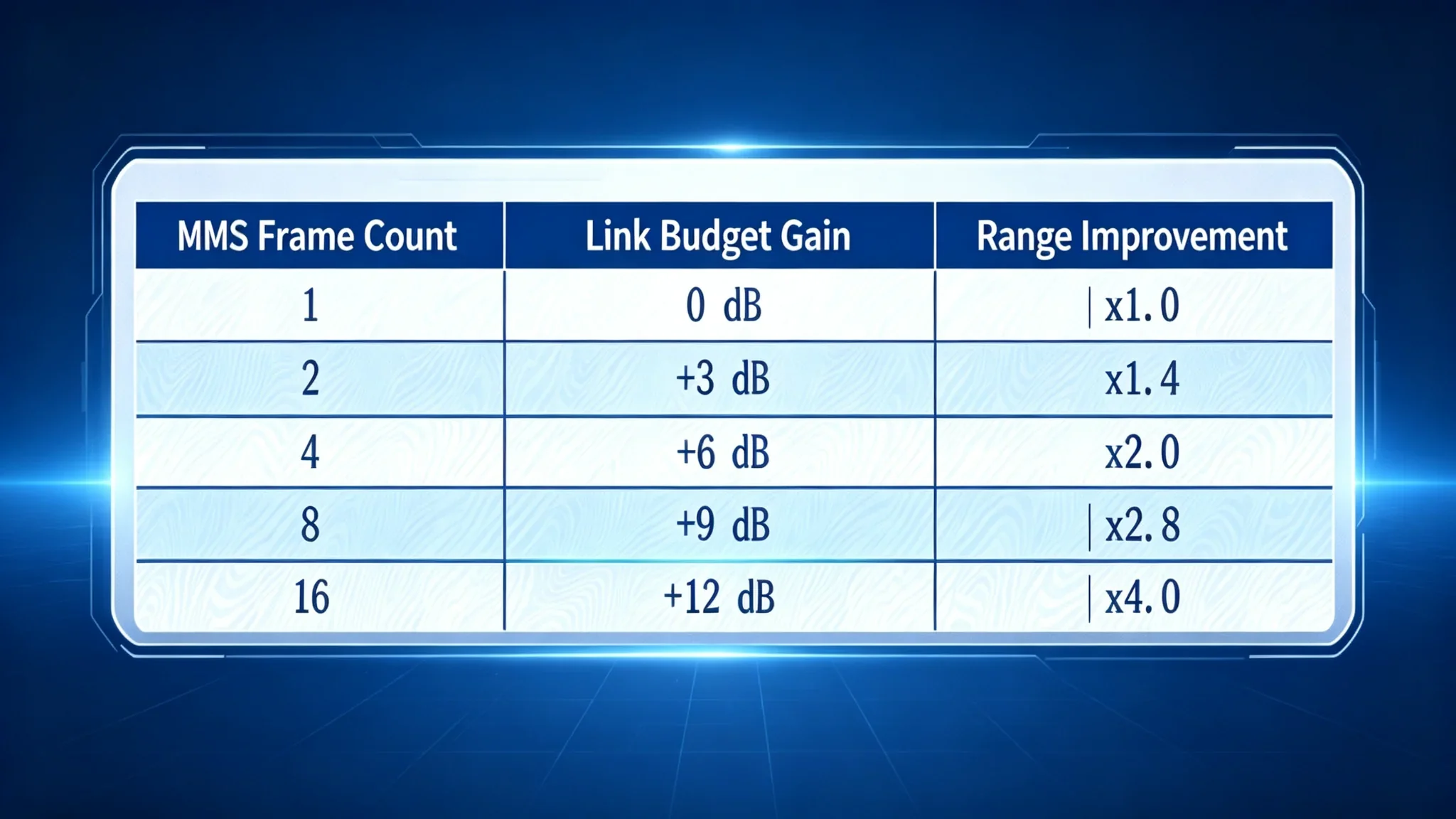
NBA-MMS may also deliver additional gain over conventional 15.4z ranging. On the one hand, a single ranging segment in MMS is short, so the instantaneous transmit power can be raised further while still meeting regulatory limits. On the other hand, the narrowband assistance link does not carry the traditional UWB data load, and its receive sensitivity can typically be better than that of 15.4z BPRF at 6.8 Mbps, which helps raise the overall link budget further.
The cost, however, is also clear: NBA-MMS brings additional narrowband transmit and receive chains, PLL, filtering, antenna and coexistence design challenges. Particularly when coexisting with systems such as 5.8 GHz Wi-Fi, NBA reception and transmission can introduce new interference and filtering challenges. Because this design needs an extra narrowband module, it is usually more expensive as well.
NBA-MMS is therefore best understood as a "stronger but more complex" enhanced ranging option.

6. HRP-LLDDEV: UWB's Data Capability Is Being Reopened
When most people hear UWB, their first thought is positioning, not communication.
That is because the dominant label for UWB in consumer electronics has indeed been ranging and positioning: digital keys, AirTag-style device finding, spatial awareness interaction and so on.
But LLDDEV in 802.15.4ab shows that UWB's low-latency data capability is being reopened.
The key element of HRP-LLDDEV is the dynamic data mode PHR. It uses PHR1 and PHR2 to support dynamic data mode: PHR1 encodes the PSDU data rate and indicates whether optional LDPC coding is used, while PHR2 carries the payload length, the ranging bit and HCS information.
The significance of this capability is that UWB no longer simply transmits ranging packets. It can choose different data rate and coding combinations according to link conditions, service type and latency requirements.
IEEE's own description of 802.15.4ab also notes that the amendment supports low-power low-latency streaming as well as high data-rate streaming, allowing at least 50 Mbit/s of throughput.
That opens up room to imagine new applications, for example:
- Wireless gaming peripherals;
- Short-range low-latency AR/VR interaction;
- Short-range high-speed data exchange;
- Low-latency control between smart devices;
- Multi-device cooperative communication inside a car or a room;
- Low-latency wireless earbuds.
Of course, UWB will not become a replacement for Wi-Fi. Its value is not in covering a large area with a high-speed network, but in offering a new way to connect in scenarios that are short range, low latency, low power and spatially aware.

7. Where Will UWB Go Under the New Standard?
The value of 802.15.4ab is not just that it adds a few technical modes; it pushes the application boundary of UWB further out.
- Main direction for HRP-ARDEV: automotive digital keys and secure access
802.15.4z already drove the development of secure ranging, and 802.15.4ab further improves link budget, ranging reliability and adaptability to complex environments. In the future an automotive digital key will not only have to unlock the door at close range; it will also have to deliver a stable experience in underground parking garages, in environments with heavy reflections, and where many devices coexist.
- Main direction for HRP-LLDDEV: low-latency lossless wireless earbuds and data transfer
Low-latency data transfer will enable more wireless device scenarios, and low-latency lossless wireless earbuds in particular are likely to become very common. High-rate, low-latency data transfer is what guarantees an excellent user experience.
The connection setup enhancements, low-latency data capability and low-power mechanisms introduced by 802.15.4ab will make these applications feel more natural.
- Main direction for HRP-SDEV: UWB radar sensing
By standardizing sensing packets, pulse shapes, frequency stitching and CIR reporting, UWB can more systematically support presence detection, human motion detection, respiration detection, child presence detection inside a vehicle, space occupancy sensing and similar scenarios.
This is also the important path by which UWB moves from positioning toward integrated sensing and communication.
- Beyond that: industrial positioning and asset tracking
In industrial, warehousing, robotics, hospital and mining scenarios, high-precision positioning is still the core value of UWB.
The 802.15.4ab enhancements to link budget, interference mitigation, device density, high-integrity ranging and infrastructure synchronization help make UWB more usable in complex industrial environments.

8. Closing: UWB Is Turning from a Positioning Chip into a Spatial Intelligence Interface
Looking back at the evolution of UWB, a clear path emerges:
- 802.15.4a turned UWB into a high-precision ranging technology;
- 802.15.4z strengthened secure ranging;
- 802.15.4ab pushes UWB further into sensing, low-latency data, low-power connectivity and enhanced ranging.
From a standards perspective, the significance of 802.15.4ab is not merely that UWB gained a few more modes; it redefines the boundary of what UWB can do.
It means UWB is no longer just answering the question "how far apart are these two devices". It is starting to answer many more:
- Is there someone in the space?
- Is the target moving?
- Can devices communicate with each other at low latency?
- Can a battery-powered device stay on standby for a long time?
- Is ranging still reliable in a complex environment?
- Can phones, cars, home appliances and industrial equipment share a common foundation for spatial interaction?
In the future, UWB will probably no longer be just a selling point of a positioning chip. It will become the spatial intelligence interface that connects the physical world with digital systems.
And IEEE 802.15.4ab is a key step in that evolution.
Note: all illustrations in this article were generated by artificial intelligence.

Building the UWB industry together and expanding the intelligent connected future. Whether you are exploring business cooperation, planning a deployment for a specific scenario, or bringing a completely new application idea, we look forward to talking with you, working together and unlocking more of what UWB can do.
Shenzhen Chipsbank Percomm Technologies Co., Ltd.
Tel: 0755-88835998
E-mail: uwb@chipsbank.com
Address: 7F, Building 12, Phase II, Software Park, Kejizhong 2nd Road, Yuehai Street, Nanshan District, Shenzhen