Ranging & Positioning
DS-TWR
DS-TWR: Double Sided Two-Way Ranging
SS-TWR is simple, but the clock reference difference between transmitter and receiver introduces ToF error. Chipsbank has done extensive development work to address this shortcoming of SS-TWR by compensating for the clock error: clock frequency error is generally at the ppm level and can be compensated down to ppb. When signal strength is poor, ranging error exceeds 2 m without compensation; with compensation we can reduce the error to less than 2 cm.
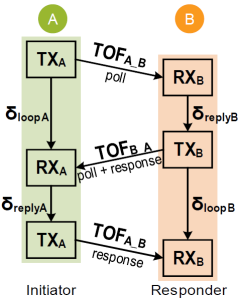
If Chipsbank's clock compensation scheme is not used, Double Sided Two-Way Ranging (DS-TWR) can solve this problem, as shown below.
Each device can compute its own ToF, and then improve measurement accuracy by compensating for the clock differences between the two devices.
This method consumes more power because it involves the transmission of three frames.