
Ranging & Positioning
How UWB Ranging Works
Narrow-pulse modulation: BPSK and BPM
Unlike other radio technologies, UWB does not use amplitude or frequency modulation to encode the information its signal carries. Instead, UWB uses very short sequences of narrow pulses (just 2 nanoseconds), encoding data with binary phase shift keying (BPSK) and/or burst position modulation (BPM). These narrow pulses also have clean edges, so the time of arrival and the distance can be determined precisely even when multipath effects from reflections are present.
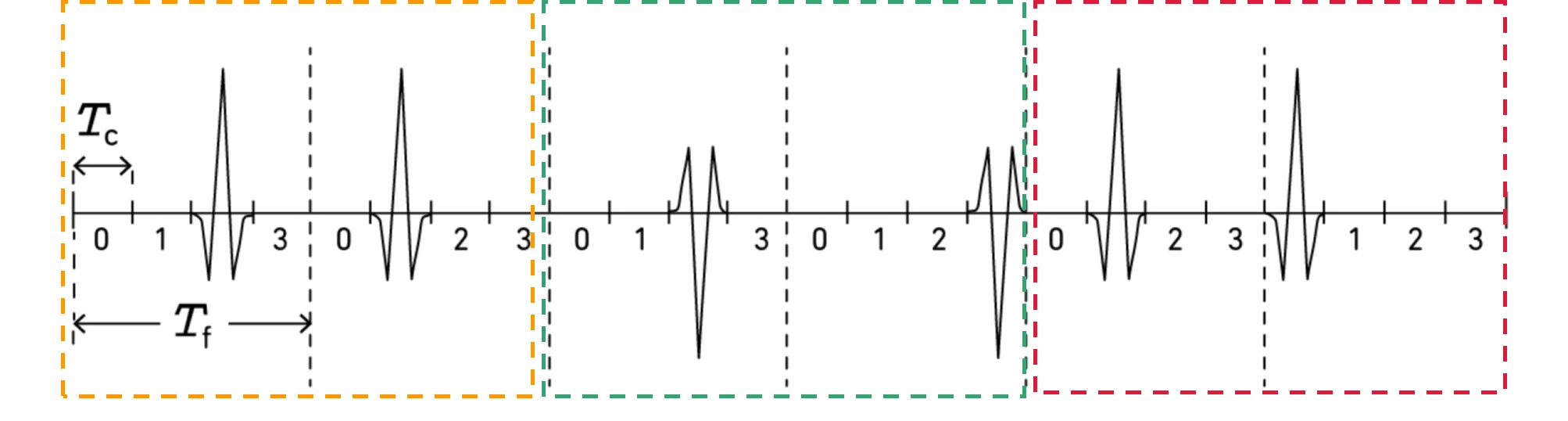
In the BPSK example below, two consecutive impulse radio (IR) signals represent one symbol. An IR signal can occupy one of the chip intervals (Tc) within a frame (Tf). A time-hopping (TH) code determines the precise position of the signal within its dedicated time frame, reducing the chance of interference between UWB systems. In the example, the TH codes of the symbols are {2, 1}, {2, 3} and {1, 0}, so the first and second signals are shifted by two and one chip interval respectively, and so on. Here the information corresponds to the polarity of the signal, so the IR stream represents the binary data "101".
ToF: time × speed of light = distance
Combined with the use of ToF information, this lets UWB compute an accurate distance estimate even indoors, where multipath reflections are common. Using timestamped signals, UWB calculates the time the signal takes to travel between devices, then multiplies that time by the speed of the signal (the speed of light) to obtain the distance.
The figure below shows the advantage of using ToF to compute distance indoors. In the figure, the UWB signal transmitted by the blue device reaches the grey device on the wall by several different paths. One path goes directly through the intervening wall to the grey device; the other paths are longer because they involve reflections. Because the direct path is the shortest, it arrives at the grey device first and is used to compute ToF. The other signals can be ignored. Think of it as a race: many runners reach the finish line, but only the first one wins.
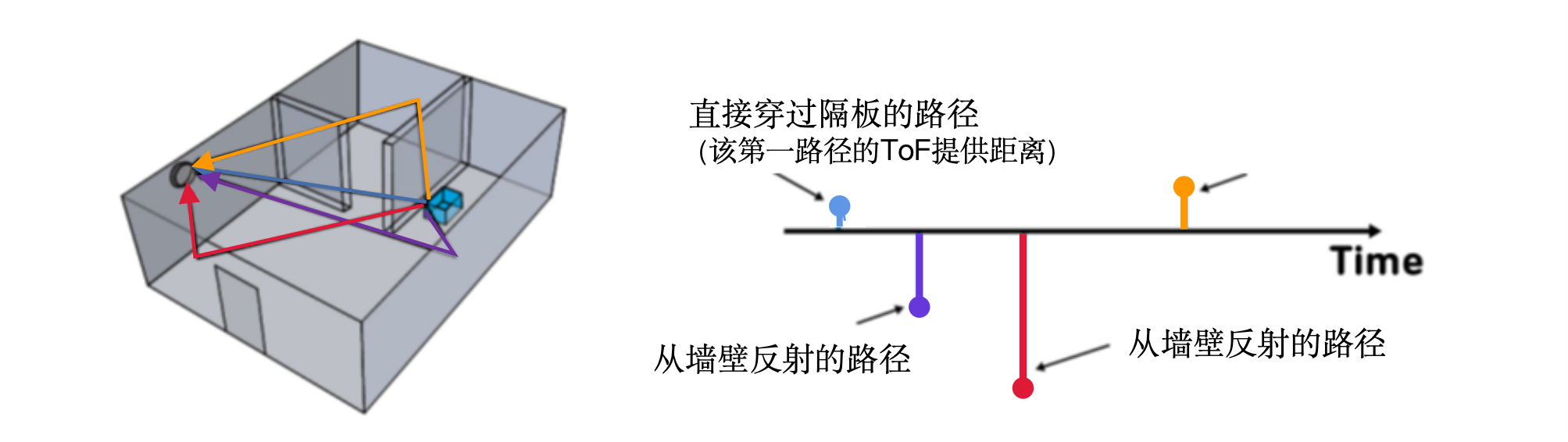
This method is unaffected by signal strength, so if the direct signal is attenuated after passing through an intervening wall, the result is not affected.