Ranging & Positioning
TDoA
TDoA: Time Difference of Arrival
Time Difference of Arrival (TDoA) is a highly scalable way to determine the position of tags within a venue. Because a tag only needs to transmit once during the whole process, it consumes very little power and therefore has a very long battery life.
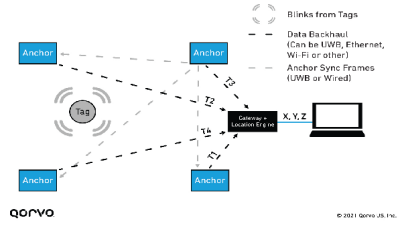
Multiple anchors are deployed at fixed, known positions and tightly time-synchronised. When a mobile device sends a "beacon" or "blink" signal, every anchor that receives it timestamps the arrival against a common synchronised time base. The timestamps from the anchors are then forwarded to a central location engine, which runs multilateration algorithms to determine the device's position from the differences in arrival time at each anchor. The result is a 2D or 3D position of the mobile device, as shown below. This method is commonly used in RTLS (Real Time Location Systems).
Reverse TDoA: a GPS-like mode
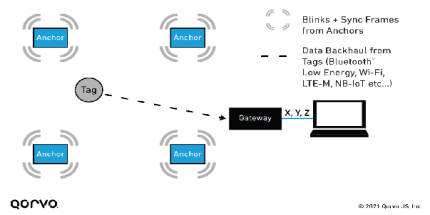
Reverse Time Difference of Arrival (Reverse TDoA). A reverse TDoA system similar to GPS can also be implemented. The anchors transmit synchronised blink signals (with fixed, known offsets to avoid collisions), and the mobile devices use TDoA and multilateration to compute their own positions, as shown below.