Ranging & Positioning
SS-TWR
To understand distance and position measurement with UWB, it is important to know the terms "anchor" and "tag". An anchor is typically a fixed UWB device at a known position. A tag usually means a mobile UWB device. Anchors and tags exchange information to establish the distance between them. By communicating with multiple anchors, the precise position of a tag can be determined. Some devices can act as anchor, tag, or both — for example, when two phones use UWB to work out the distance between them, they may alternate between the tag and anchor roles during the process.
Two-Way Ranging (TWR) determines the time (ToF) a UWB radio signal takes to travel back and forth between tag and anchor, then multiplies that time by the speed of light to compute distance. Keyless car entry systems are a classic example of using TWR for secure and accurate distance determination.
Single Sided – Two Way Ranging (SS-TWR)
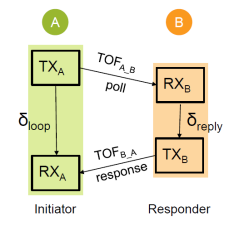
The transmitter (A) sends a Poll signal to receiver B.
δreply is the time from B receiving the signal to sending its response — effectively the processing time (delay) inside the receiver. Since ToFA→B = ToFB→A, the transmitter knows the total time from transmission to reception.
Therefore: δloop = 2 × ToFA→B + δreply
So we can compute ToFA→B = (δloop − δreply) / 2, and hence the distance: distance = ToF × speed of light.