
Ranging & Positioning
PDoA
PDoA: Phase Difference of Arrival
Phase Difference of Arrival (PDoA) lets two devices work out their relative position without any other infrastructure, using a combination of distance and direction information. This matters for peer-to-peer applications, or for reducing the amount of infrastructure that has to be deployed.
For PDoA, one of the devices must carry at least two antennas. When that device receives a signal from the other device, it measures the phase difference of the arriving signal at each antenna and converts the measured phase difference into a distance difference: P = λ × Δφ / (2π). With the distance obtained from time of flight, the rest is high-school mathematics — a few equations give the direction of the incoming signal.
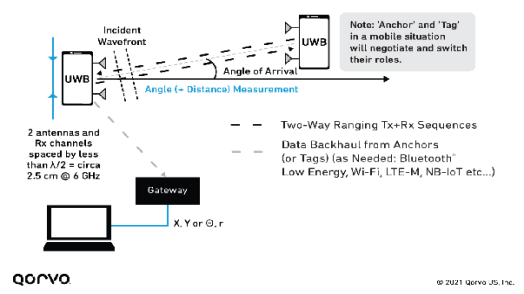
The receiving device now knows the direction and distance of the transmitting device — the physical basis for "spatial awareness" interactions such as connecting to whichever device a phone is pointed at. Chipsbank's CBU5000 1T3R architecture can further deliver 3D AoA (three-dimensional angle of arrival).